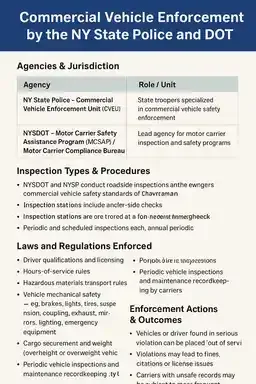
1. Agencies & Units Involved
-
The NYSP runs a dedicated unit called the Commercial Vehicle Enforcement Unit (CVEU). According to their website, the CVEU was created in 1997 by consolidating motor‐carrier safety, hazardous materials and scale‐enforcement details into one unit focused on commercial vehicle safety.
-
The NYSDOT is the lead state agency for the Motor Carrier Safety Assistance Program (MCSAP) in New York; it works in conjunction with NYSP (and local law enforcement) to conduct roadside inspections and enforcement of commercial motor vehicles (CMVs).
-
Additionally the Federal Motor Carrier Safety Administration (FMCSA) provides federal rules and frameworks (hours of service, driver qualification, etc.) that NY enforcement implements or references.
2. Purpose & Enforcement Objectives
-
The main objective: “promote highway safety and reduce commercial vehicle related crashes and hazardous materials incidents by removing unsafe trucks, unsafe loads, and unqualified drivers from the highways.”
-
The CVEU’s role: all troopers assigned to CVEU are trained and certified to perform full‐scale inspections (CVSA Level 1 inspections) of large commercial vehicles, hazardous materials/cargo tanks, etc.
-
Enforcement is not just about vehicle defects — it also targets unsafe driving behaviour (speeding, improper lane changes, etc.) of commercial vehicles.
3. Key Enforcement Activities & Inspection Points
Here are some of the major enforcement/inspection activities carried out:
-
Roadside inspections: Vehicles are selected (at weigh stations, mobile enforcement sites, etc), driver stays in the vehicle, inspector runs through standardized inspection protocols (as per CVSA standards) covering driver documentation, vehicle safety, cargo securement, etc
-
Weight/dimension/permit enforcement: The agencies check whether vehicles are within legal weight and dimension limits; whether oversize/over-weight loads have the required state permits. For example, NYSP’s website lists maximums (single axle, tandem axle, vehicle length/width/height) for certain vehicles.
-
Licensing/driver qualification: Ensuring the driver holds a correct commercial driver’s license (CDL), medical certificate, and that the carrier meets safety fitness via programs like PRISM.
-
Cargo securement & hazardous materials: Inspectors check that cargo is properly secured, that hazardous materials transport meets placarding and packaging rules. The CVEU site references this under the definition of Commercial Motor Vehicle and HazMat rules.
-
Parking, standing and stopping rules (especially in urban areas): In places like the city, commercial vehicles have additional restrictions (e.g., parking rules) enforced by the NYC DOT and local modules—but state enforcement may intersect.
4. Legal Definitions & State-Federal Interplay
-
A commercial motor vehicle (CMV) under federal rule 49 CFR §390.5 is defined (among other things) as any vehicle:
-
with a gross vehicle weight rating (GVWR) or gross combination weight rating (GCWR) of 10,001 lbs or more; or
-
designed to transport more than 8 passengers (including driver) for compensation; or
-
etc.
-
-
New York’s enforcement framework incorporates these federal definitions and then layers state‐specific requirements (permit, registration, parking, etc).
-
Example: The state sets maximum width on highways: 96 inches generally, 102 inches on designated highways.
5. Permits, Oversize/Overs Weight & Escort Requirements
-
For oversize/overweight loads in New York, state permits are required. The NYSP page spells out rules for requesting police escort of oversized vehicles (via NYSDOT permits & route surveys).
-
The CVEU site gives details: valid NYSDOT special hauling permit, valid route survey, etc must be submitted at least two full business days ahead.
6. Consequences & Compliance Risks
-
If a vehicle fails inspection (serious defects, hours of service violation, unqualified driver), it may be placed “out‐of‐service” (OOS) until remedied. The state uses the standard CVSA out‐of‐service criteria.
-
Carriers with poor safety performance can be flagged via the PRISM program (see next section) which links to registration and can result in extra oversight or suspension of registration.
-
Violating state parking/standing rules for commercial vehicles in NYC can result in fines, towing, etc.
7. Carrier & Driver Best Practices for Compliance
To stay ahead of enforcement and reduce risk, carriers and drivers should consider the following:
-
Ensure drivers have valid CDL, medical certificate, hours of service logs are accurate (and if required, the ELD is functioning).
-
Ensure vehicles are registered properly, weights/axles are within state limits, cargo is secured, hazardous materials are handled correctly.
-
If carrying oversize or overweight loads, make sure you have the correct NYSDOT special permit, route survey, any municipal permits, and if needed an escort arranged with NYSP.
-
Be ready at roadside for inspections: driver should stay in vehicle, provide requested documents (logbook, driver qualification file, vehicle inspection/maintenance records).
-
For urban operations (especially NYC): become familiar with local rules for parking/standing, truck route designations, and commercial versus non-commercial definitions.
-
Monitor your carrier’s safety performance metrics: crashes, inspections, violations — since programs like PRISM use those to trigger increased oversight.
-
Stay updated: enforcement agencies (NYSP, NYSDOT) update training, laws, inspection focus periodically (for example HazMat changes, cargo securement updates). The CVEU provides updates to its troopers yearly.
8. Why This Matters for Carriers Operating in New York
-
New York has dense road networks, many urban constraints, unique parking/truck‐route rules, and heavy enforcement presence. The partnership between NYSP and NYSDOT means inspecting carriers should expect coordination across agencies.
-
Enforcement is not just about vehicle defects: unsafe driving behaviours of CMVs are targeted (speeding, improper passing) which means carriers need to emphasize safe driver behaviour and training.
-
Non-compliance can lead not only to fines and out-of-service orders but can also impact your carrier’s registration, operating authority, insurance costs, and reputation.
-
Because federal rules apply (via FMCSA) and state rules layer on top, operating within New York means you must be fluent in both sets of regulations.