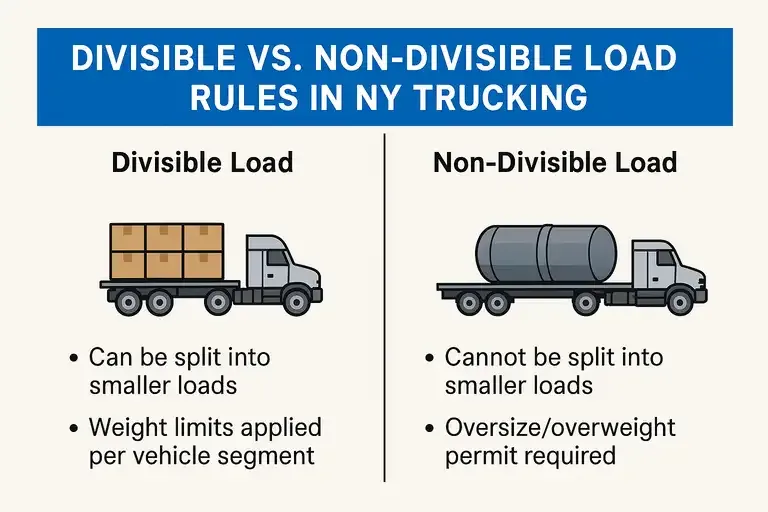
What is a Divisible Load?
A divisible load is defined by NYSDOT as:
“any vehicle or combination of vehicles transporting cargo of legal dimensions that **can be separated into units of legal weight without affecting the physical integrity of the load.”
Examples of divisible loads include: sand, top soil, gravel, stone, logs, scrap metal, fuel, milk, trash/refuse/garbage.
Key takeaway: if your cargo can legally be split or divided into smaller loads (without destroying its value/use) then it likely classifies as divisible.
What is a Non-Divisible Load?
NYSDOT defines a non-divisible load (for purposes of its Special Hauling Permit program) as:
“any load or vehicle exceeding applicable length or weight limits which, if separated into smaller loads or vehicles, would:
a) Destroy the value of the load or vehicle (i.e., make it unusable for its intended purpose); or
b) Require more than 8 work-hours to dismantle using appropriate equipment; or
c) Compromise the intended use of the vehicle, i.e., make it unable to perform the function for which it was intended.”
In the regulations: “nondivisible load shall mean one piece or item which cannot be separated into units of less weight without affecting the physical integrity of the load.”
Examples: modular buildings, large transformers, cranes, self-propelled construction equipment (backhoes, drilling rigs) that simply cannot be broken down without losing functionality/value.
Why the Distinction Matters
-
NYSDOT issues separate permit types depending on whether the load is divisible or non-divisible. For non-divisible loads, you apply for a Special Hauling Permit (often referred to as a “non-divisible load” permit).
-
For divisible loads, the state issues Divisible Load Overweight Permits under its general overweight/oversize permitting scheme.
-
If a load can be divided yet you attempt to move it as a single oversized unit, the permit may be denied. NY regulations are clear that “A permit will not be issued for any load which can be reduced to legal weight or dimensions.”
Practical Application — How to Determine
Here’s a quick assessment checklist:
| Question | If Yes → Non-Divisible | If No → Divisible |
|---|---|---|
| Can I separate the cargo into smaller units without destroying its value or intended use? | If No, likely Non-Divisible | If Yes, likely Divisible |
| Would dismantling the load take more than 8 work-hours (using proper equipment)? | If Yes, Non-Divisible | If No, Divisible |
| Would separation compromise the vehicle’s or equipment’s function? | If Yes, Non-Divisible | If No, Divisible |
Permit Implications
-
Non-Divisible Load Permit: Requires you to apply under NY’s “Special Hauling Permit” regime. A route must often be approved, conditions imposed (escort vehicles, restricted travel times), and special fees apply.
-
Divisible Load Overweight Permit: Applies if the load is overweight (or over-dimension) but is deemed divisible. There are standardized permit types (e.g., Type 1, Type 1A) with fixed fees and weight limits.
-
Travel Restrictions: Even with a permit, there are “permissible hauling days” and sometimes limitations on hours (daylight, weekdays) for non-divisible loads.
What Carriers Should Do
-
Assess your load: Before assume it’s non-divisible just because it is heavy/large. If you can break it down without impairing value/use — it may be divisible.
-
Choose the right permit path: If non-divisible → Special Hauling Permit. If divisible → Divisible Load Overweight Permit.
-
Prepare documentation: For non-divisible loads, you may need to justify why the load cannot be separated (e.g., a large transformer, a modular unit).
-
Plan your route: Especially for non-divisible, you often must adhere to approved route, specified travel times, possibly escort vehicles.
-
Check for local limitations: Even with state permit, individual counties/cities may have additional restrictions or require additional approval.