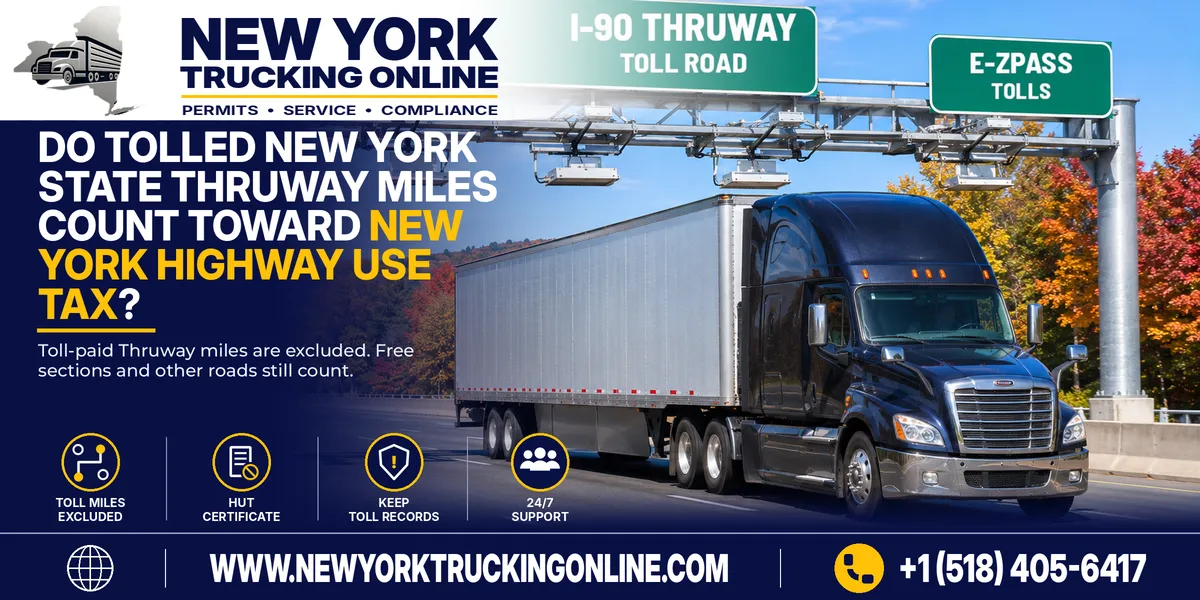
Do Tolled New York State Thruway Miles Count Toward New York Highway Use Tax?
Table Of Contents
-
Introduction
-
The Short Answer
-
What New York Law Says
-
Toll-Paid Miles vs Free Miles
-
Why You Still Need a HUT Certificate
-
How to Separate Thruway Miles
-
A Simple Example
-
Records That Back Up Your Thruway Miles
-
Common Mistakes to Avoid
-
Why Many Trucking Companies Choose Our Service
-
FAQ
Introduction
The New York State Thruway is one of the busiest freight corridors in the country. It links New York City, Albany, Syracuse, Rochester, and Buffalo, and many trucks crossing the state spend a big share of their miles on it.
Truckers already pay tolls on the Thruway. So a common question comes up at tax time: do those same miles also count for the New York Highway Use Tax? The answer can make a real difference on a quarterly return. This guide explains what the law says, which Thruway miles are left out, and how to keep the records that prove it.
The Short Answer
No, not if you paid the toll. Miles on the parts of the Thruway where the Thruway Authority charges a toll are not counted as taxable miles for the New York Highway Use Tax.
Miles on free roads, including any Thruway sections where no toll is charged, are still taxable. Your truck also still needs a HUT certificate and decal to run on New York's other highways.
What New York Law Says
The rule is in New York Tax Law Section 501(6), which defines "public highway" for the highway use tax.
The definition is broad. It covers any public highway, street, avenue, road, public place, public driveway, or other public way. But it adds an exception: for the sections that set the tax, "public highway" does not include any portion of the Thruway where the Thruway Authority has charged a fee for its use.
The tax itself, under Section 503, is based on the miles a truck travels on New York's public highways. Since toll-paid Thruway sections are not "public highways" for this purpose, those miles fall outside the tax.
The idea is simple. A carrier paying tolls for the Thruway is already paying for that road, so the state doesn't charge the New York Highway Use Tax on the same miles.
Toll-Paid Miles vs Free Miles
The exception depends on whether a toll was charged, not on the road's name.
-
Toll-paid Thruway miles. Not taxable for the New York Highway Use Tax.
-
Thruway sections with no toll. The exception only covers portions where a fee is charged. Free sections count as taxable miles.
-
Interstates and state roads off the Thruway. Taxable, no matter how heavy the traffic or how much of the route they make up.
-
Local streets and roads to customers. Taxable.
Before you leave any Thruway miles off a return, confirm that a toll was actually charged for that stretch.
Why You Still Need a HUT Certificate
Leaving toll-paid miles off the tax doesn't remove the need to register. Almost every truck that uses the Thruway also drives on other New York roads, such as the roads to a warehouse, a truck stop, or a delivery site.
Those miles are on public highways, so the truck must be covered by the New York Highway Use Tax. That means a HUT certificate and decal for regular operation, or a trip certificate for a short visit. The Thruway exception changes how much tax you owe, not whether you need to be registered.
How to Separate Thruway Miles
-
Log Every New York Trip. Record the route, start and end points, and total New York miles.
-
Mark the Toll-Paid Sections. Note where the truck got on and off the Thruway and where tolls were charged.
-
Calculate Thruway Miles. Use the distance between the entry and exit points.
-
Subtract From Total New York Miles. What's left are the taxable miles for the New York Highway Use Tax.
-
Keep the Proof. Save toll statements and trip records with your return file.
A Simple Example
A tractor-trailer enters New York from Pennsylvania, drives local roads to the Thruway, and takes the tolled Thruway east. It then leaves the Thruway and drives local roads to a warehouse.
-
Total New York miles: 320
-
Toll-paid Thruway miles: 250
-
Miles on other roads: 70
In this example, only the 70 miles on other roads count for the New York Highway Use Tax. The 250 toll-paid Thruway miles are excluded. That's a big difference in the tax owed for that trip.
Records That Back Up Your Thruway Miles
If you leave Thruway miles out of your taxable total, you should be able to show where they came from during an audit. Helpful records include:
-
Toll statements, such as E-ZPass account statements showing entry and exit points and dates
-
Trip sheets or driver logs showing the route for each trip
-
ELD or GPS data with the times and locations on and off the Thruway
-
Dispatch records that match the loads to the routes
The more each trip's records match, the easier it is to support the miles you left off.
Common Mistakes to Avoid
-
Excluding free sections. Only toll-paid portions are left out of the tax.
-
Skipping registration. The truck still needs a HUT certificate for other New York roads.
-
Guessing Thruway miles. Use real entry and exit points, not estimates.
-
Throwing out toll records. Keep them with your mileage records.
-
Counting other toll roads. The exception in Section 501(6) is written for the Thruway.
Why Many Trucking Companies Choose Our Service
New York Trucking Online helps carriers set up their New York Highway Use Tax account and keep Thruway and non-Thruway miles organized, so each return shows the right taxable miles.
We provide 24/7 support and work weekends and holidays.
or
FAQ
Do toll-paid Thruway miles count toward New York Highway Use Tax?
No. Tax Law Section 501(6) leaves toll-paid Thruway portions out of "public highway" for the tax.
Are free Thruway sections taxable?
Yes. The exception only covers portions where the Thruway Authority charges a toll.
Do I still need a HUT certificate if I mostly use the Thruway?
Yes. Your truck still uses other New York roads, which are subject to the tax.
What records support excluded Thruway miles?
Toll statements, trip sheets, ELD or GPS data, and dispatch records.
Does the exception apply to other toll roads?
Section 501(6) names the Thruway. Miles on other roads are treated as public highway miles.
For more information, visit the New York State Department of Taxation and Finance.