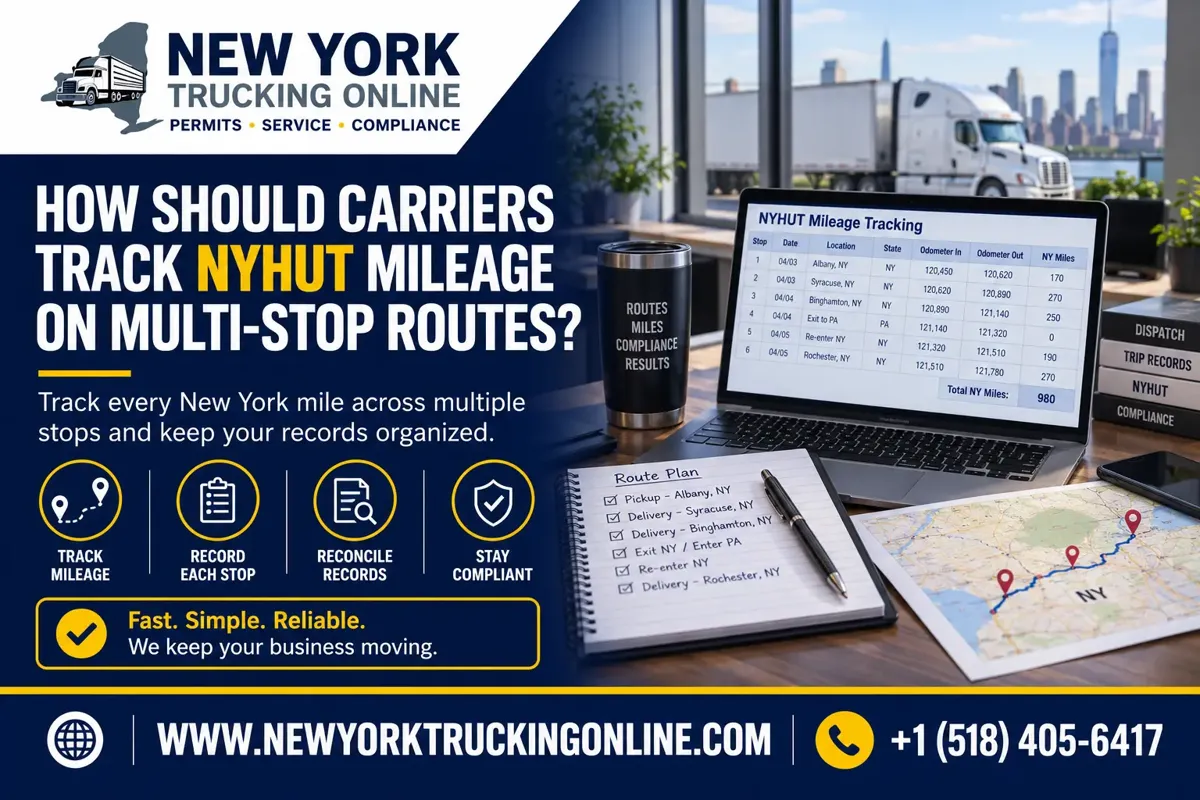
How Should Carriers Track NYHUT Mileage On Multi-Stop Routes?
Table Of Contents
-
Introduction
-
Why Multi-Stop Routes Require Careful Mileage Tracking
-
What Mileage Should Be Recorded?
-
How Should Each Stop Be Documented?
-
How Should Drivers Track New York Miles?
-
What About Toll-Paid Thruway Miles?
-
How Should Dispatch And Accounting Coordinate?
-
Common NYHUT Mileage Tracking Mistakes
-
How To Build A Reliable Tracking Process
-
Why Many Trucking Companies Choose Our Service
-
FAQ
Introduction
Multi-stop routes can make mileage tracking much more complicated than a simple point-to-point delivery. A carrier may pick up freight at one location, make several deliveries, leave New York, and later return for another stop.
For carriers subject to the New York Highway Use Tax, accurate mileage records are important because NYHUT reporting depends on the miles traveled in New York. When several stops are involved, carriers should organize the trip carefully so the reported mileage can be supported by their records.
A consistent tracking process helps dispatch and accounting identify exactly where the vehicle traveled and which miles belong in the NYHUT calculation.
Why Multi-Stop Routes Require Careful Mileage Tracking
A multi-stop route can contain several separate movements under one dispatch assignment. The truck may begin outside New York, enter the state, make several stops, cross into another state, and then return to New York.
Recording only the total mileage for the entire assignment can make it difficult to determine the actual New York mileage later.
A better approach is to document each trip segment and connect it to the correct vehicle and date. This creates a clear record that can be compared with ELD information, odometer readings, dispatch records, and other supporting documents.
What Mileage Should Be Recorded?
Carriers should track the actual mileage traveled by each applicable vehicle in New York.
The records should distinguish New York mileage from miles traveled outside the state. This is particularly important when a multi-stop route crosses state lines during the same assignment.
Carriers should also identify mileage that receives different treatment for NYHUT purposes. For example, qualifying toll-paid portions of the New York State Thruway should be supported separately.
For carriers using the gross weight method, records also need to distinguish laden and unladen New York miles when required.
The goal is to record the mileage that actually applies rather than simply using the vehicle's total trip mileage.
How Should Each Stop Be Documented?
Each stop should be connected to the vehicle, date, and route.
A useful trip record can include:
-
Starting location
-
First pickup or delivery
-
Additional stops
-
Final destination
-
New York entry point
-
New York exit point
-
Mileage for the New York portion
If the truck makes several deliveries on the same day, dispatch should keep the stop sequence clear.
This makes it easier to compare the route with the driver's mileage records and identify an unusual difference before the return is prepared.
How Should Drivers Track New York Miles?
Drivers should record the information needed to establish where each trip begins and ends and how much mileage occurs in New York.
When a route crosses the state line more than once, each entry and exit should be documented. The carrier should not treat the entire assignment as one uninterrupted New York trip.
For example, a truck could enter New York for two deliveries, leave the state for a pickup, and return for another delivery. Each segment should be reflected in the records so accounting can establish the correct New York mileage.
Accurate trip details also make it easier to investigate discrepancies later.
What About Toll-Paid Thruway Miles?
Certain toll-paid portions of the New York State Thruway are excluded from the highway use tax calculation.
Because this mileage receives different treatment, carriers should maintain records supporting qualifying Thruway travel. Toll receipts, invoices, or other reliable records can help establish the mileage.
On a multi-stop route, carriers should avoid simply estimating the amount of Thruway mileage to remove from the total.
The supporting documentation should be connected to the appropriate vehicle and trip so the mileage can be verified if needed.
How Should Dispatch And Accounting Coordinate?
Mileage tracking becomes much easier when dispatch and accounting use the same vehicle and trip information.
Dispatch should provide accounting with completed trip records showing the route, dates, stops, and any state-line crossings.
Accounting can then compare those records with ELD information, odometer readings, and other mileage documentation before preparing the NYHUT return.
New York requires daily records for each vehicle subject to HUT recordkeeping requirements. Keeping the information organized by vehicle helps maintain a clear connection between the actual operation and the reported mileage.
Common NYHUT Mileage Tracking Mistakes
One common mistake is recording only the total mileage for an entire multi-stop assignment.
Another is failing to document every New York entry and exit when the truck crosses the state line more than once.
Carriers may also overlook qualifying toll-paid Thruway mileage or fail to retain documents supporting it.
Another problem occurs when dispatch identifies the truck by one unit number while accounting uses a different identifier. Even accurate mileage becomes difficult to verify when the records cannot be clearly connected to the same vehicle.
How To Build A Reliable Tracking Process
The best process starts before the truck leaves.
Dispatch should assign the correct vehicle, list the planned stops, identify the expected New York route, and establish how drivers will record entries, exits, and mileage.
After the route is completed, dispatch should review the trip record before sending it to accounting.
Accounting should then compare the reported mileage with the supporting records and resolve unusual differences before filing.
Carriers should retain the records in an organized system so each trip can be traced from dispatch through the final NYHUT report.
A consistent process can reduce errors and make reporting much easier.
Why Many Trucking Companies Choose Our Service
Many trucking companies choose New York Trucking Online because multi-stop operations can make NYHUT mileage tracking more difficult to manage.
Our service helps simplify New York permit and tax-related processes with experienced permit specialists, fast processing, secure online applications, and convenient customer support.
We help carriers organize their New York requirements and keep their compliance process easier to manage.
FAQ
Why Is Multi-Stop Mileage More Difficult To Track?
Multiple pickups, deliveries, state-line crossings, and mileage categories can make a single assignment harder to reconcile. Separating each trip segment creates clearer records.
Should Carriers Track NYHUT Mileage By Vehicle?
Yes. New York requires daily mileage records for each vehicle subject to HUT recordkeeping requirements.
Should New York Miles Be Separated From Out-Of-State Miles?
Yes. Carriers should maintain records that distinguish New York mileage from mileage traveled elsewhere.
What If A Truck Enters New York More Than Once?
Each entry and exit should be documented so the carrier can establish the actual New York mileage.
How Should Toll-Paid Thruway Mileage Be Handled?
Qualifying toll-paid Thruway mileage should be identified separately and supported with appropriate records.
Can ELD Records Help With NYHUT Tracking?
Yes. ELD records can provide useful supporting information when reviewed together with trip, route, and vehicle records.
What Should Dispatch Provide To Accounting?
Dispatch should provide vehicle information, dates, origins, destinations, stop sequence, New York mileage, and supporting trip documentation.
How Can Carriers Reduce NYHUT Mileage Errors?
Track each route by vehicle, document every stop and state-line crossing, reconcile mileage before filing, and retain supporting records.
For more information, visit the New York State Department of Taxation and Finance.