1. Know Which NYC Crossings Allow Commercial Vehicles
Not every bridge or tunnel in NYC is open to commercial traffic.
Commercial Vehicle–Friendly Crossings
These crossings allow commercial trucks (within legal weight/size limits):
-
George Washington Bridge (GWB)
-
Goethals Bridge
-
Outerbridge Crossing
-
Bayonne Bridge
-
Verrazzano-Narrows Bridge
-
Robert F. Kennedy (RFK) Bridge / Triboro
-
Throgs Neck Bridge
-
Whitestone Bridge
Crossings Prohibited for Trucks
Trucks cannot use the following tunnels:
-
Holland Tunnel – NO trucks or hazmat
-
Lincoln Tunnel – Only some commercial vehicles; restrictions are rigid
-
Queens Midtown Tunnel – NO trucks
-
Brooklyn-Battery Tunnel (Hugh L. Carey) – NO trucks
Using the wrong tunnel is one of the most common—and expensive—violations.
2. Understand Oversize/Overweight (OS/OW) Permits in NYC
NYC has separate rules from the rest of New York State.
NYC DOT Permits Required for:
-
Oversized vehicles
-
Overweight loads
-
Specialized equipment
-
Escort vehicles
Permits must be obtained before entering NYC, and they often specify:
-
Approved routes
-
Approved bridges
-
Time-of-day travel restrictions
-
Required escorts
Failure to follow the exact approved route = permit violation.
3. Follow Time-of-Day Restrictions for Oversize Loads
NYC restricts oversize movement during:
-
Rush hours
-
Weekends and holidays
-
Nighttime (in some locations)
Many NYC bridges prohibit large loads between 6 AM – 10 AM and 3 PM – 7 PM.
Ignoring time restrictions is a direct permit violation.
4. Use ONLY NYC Truck Routes
NYC has designated Local Truck Routes and Through Truck Routes.
Before entering:
Check if your crossing connects to a truck route
Follow truck-route signage—not GPS defaults
Avoid parkways at all costs
Entering a parkway with a commercial vehicle leads to:
-
Immediate violation
-
Low-clearance dangers
-
Police response or towing
5. Verify Vertical and Horizontal Clearances
NYC is famous for:
-
Low-clearance overpasses
-
Narrow tunnels
-
Tight turns
-
Weight-posted bridges
Before traveling:
-
Check all clearances along your route
-
Use NYC DOT’s real-time traffic tools
-
Avoid unverified shortcuts from GPS apps
6. Confirm HazMat Restrictions
NYC has extremely strict hazardous materials (HM) rules.
HazMat trucks are banned from:
-
All NYC tunnels
-
Many Manhattan streets
-
Certain bridge levels or lanes
HazMat carriers must use designated HM-approved crossings and obtain proper permits.
7. Use a Toll Transponder That Supports Truck Rates
NYC bridges and tunnels are managed by:
-
MTA Bridges & Tunnels
-
Port Authority of NY & NJ
Incorrect transponder settings can create violations or flags on carrier profiles.
Set your E-ZPass for:
-
Correct axle count
-
Correct vehicle classification
8. Keep NYC DOT Permit Documentation Available
Drivers must have:
-
NYC DOT OS/OW permit
-
Route map
-
Instructions
-
Escort documentation (if required)
Make sure drivers know:
What bridges are allowed
What tunnels are blocked
What time windows apply
9. Train Drivers on NYC Route Behavior
Driver education prevents 90% of NYC violations.
Training should include:
-
Understanding “NO TRUCKS” signs
-
Avoiding parkways
-
Knowing legal crossings
-
Handling detours without violating route permits
-
What to do if GPS gives an illegal route
10. Use Professional Truck Route GPS Apps
Standard car GPS or Google Maps will often route trucks into:
-
Parkways
-
Low clearances
-
Illegal tunnels
-
Restricted streets
Use apps specifically designed for commercial routing.
Summary
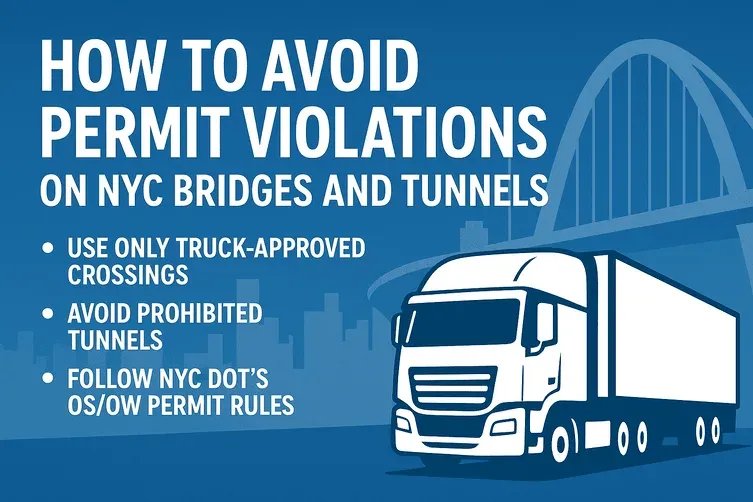
Avoiding permit violations on NYC bridges and tunnels requires:
-
Using only truck-approved crossings
-
Avoiding prohibited tunnels
-
Following NYC DOT’s OS/OW permit rules exactly
-
Staying on designated truck routes
-
Respecting weight, size, hazmat, and time restrictions
With proper planning, carriers can operate safely and legally through one of the most heavily regulated metropolitan areas in the U.S.