What “Interstate” Means
An interstate carrier operates:
-
Across state lines OR
-
In commerce that crosses state borders
If your route enters or exits New York to another state, you must meet interstate permit and registration standards.
1. Federal Registration Requirements
Interstate carriers must comply with federal rules administered by the Federal Motor Carrier Safety Administration (FMCSA):
USDOT Number
Required for:
-
All interstate carriers
-
Vehicles involved in interstate commerce
This number identifies your company with the FMCSA.
Operating Authority (MC Number)
For for-hire carriers and certain private carriers:
-
MC authority from FMCSA is required before hauling freight.
IFTA (International Fuel Tax Agreement)
If you operate in multiple states:
-
You need an IFTA license for fuel tax reporting.
IRP (International Registration Plan)
If you operate in multiple states or Canadian provinces:
-
You must register under IRP and get apportioned plates.
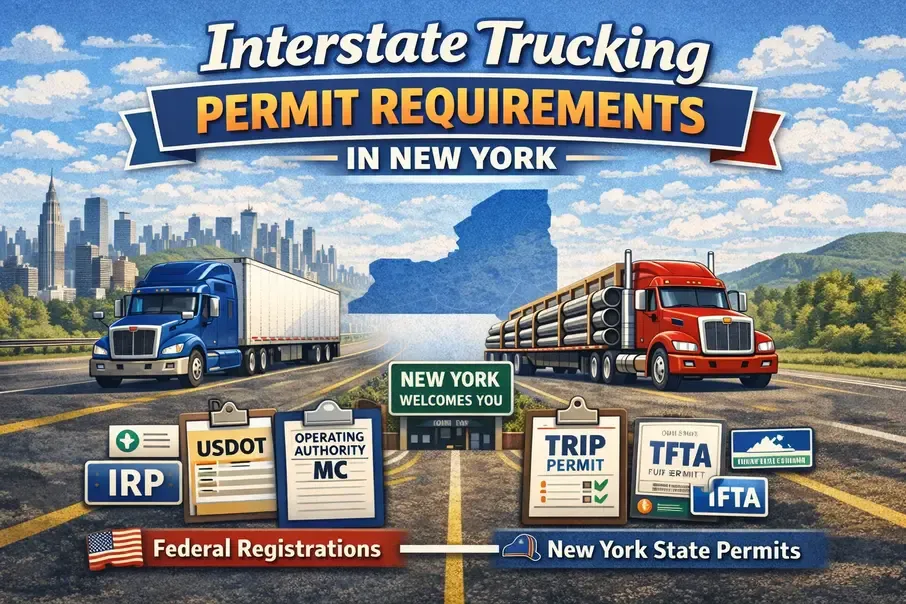
Note: These federal registrations are separate from New York state permits.
2. New York State Permit Requirements
While interstate carriers meet federal registrations, New York also enforces specific state permit requirements:
Oversize/Overweight Permits
Required when your load exceeds New York’s legal limits:
-
Weight: Exceeds state or federal maximums
-
Dimensions: Over length, width, or height limits
New York offers:
-
Single-Trip Permits
-
Annual Permits
-
Superload Permits (for extremely large or heavy loads)
Trip & Fuel Permits for Non-IRP/IFTA Carriers
If your interstate trucker:
-
Does not have IRP plates
-
Does not have IFTA credentials
You may need:
-
New York Trip Permit
-
New York Temporary Fuel Permit
These allow legal travel in NY without full IRP/IFTA credentials.
3. Permit Application & Processing
Online
Use online permit system—often faster and easier - https://www.newyorktruckingonline.com/
Be sure your application includes:
-
Accurate vehicle/axle weights
-
Load dimensions
-
Trip dates
-
Routes
Processing Time
-
Routine permits: Often same-day or next-day
-
Superload permits: Can take several days for approval
4. Route Restrictions & Approvals
For oversize/overweight loads:
-
Route approval may be necessary
(Especially near bridges, tunnels, or restricted roadways) -
Some roads (like parkways in NYC) prohibit large vehicles
Always plan your route ahead of time.
5. Enforcement & Compliance
State enforcement officers may check permits at:
-
Weigh stations
-
Roadside inspections
-
Ports of entry
You must be able to produce:
-
Valid permits
-
Registration documents
-
Insurance proof
-
Driver credentials
Failure to comply can result in:
-
Fines
-
Out-of-service orders
-
Permit revocation
6. Best Practices for Interstate Carriers
Apply for needed permits before entering New York at https://www.newyorktruckingonline.com/
Ensure all dimensions/weights on permits are accurate
Follow approved routes precisely
Carry digital or printed copies of permits
Check for local travel restrictions (e.g., NYC borough limits)
In Summary
To operate interstate trucking in New York legally:
-
Comply with federal FMCSA registrations (USDOT, MC, IFTA, IRP)
-
Obtain New York state permits for oversize/overweight and temporary trips
-
Ensure accurate paperwork and permit copies during travel