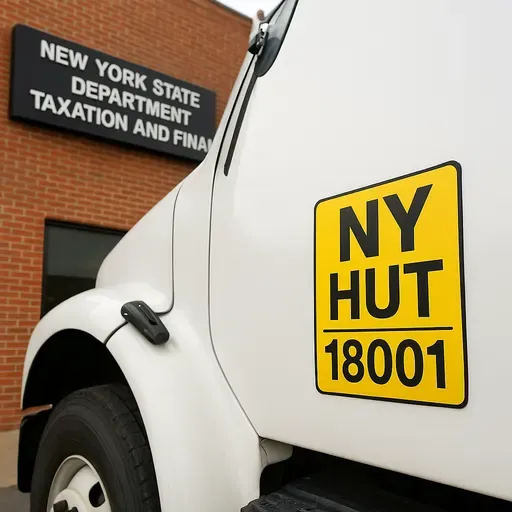
What is HUT?
The HUT is a tax imposed by the New York State Department of Taxation and Finance on motor carriers operating certain motor vehicles on New York public highways (excluding toll-paid portions of the New York State Thruway).
It is not simply a permit—it’s based on mileage and weight of vehicles, and you must register, display decals, and file tax returns.
Who Needs a HUT Registration?
You must register and get HUT credentials if you operate (in New York public highways) a vehicle meeting the following criteria:
-
Any truck, tractor or other self-propelled vehicle with a gross weight over 18,000 pounds.
-
Alternatively, if you elect to use the “unloaded weight” method, then any truck with an unloaded weight over 8,000 pounds or any tractor with an unloaded weight over 4,000 pounds must register.
-
If the vehicle is a truck/trailer/semi-trailer (or attached device) transporting automotive fuel, and meets the weight thresholds, then you may need the separate AFC (Automotive Fuel Carrier) certificate.
Important:
-
The law covers both interstate and intrastate carriers operating in New York.
-
Certain vehicles are excluded or exempt (for example, agricultural use, certain construction vehicles, etc.).
-
If you only “occasionally” operate a vehicle in New York, there is a trip certificate alternative (see below).
How to Get the HUT Registration (and Decal)
Steps to apply:
-
Establish an account:
Go to www.newyorktruckingonline.com -
Complete the application:
-
Pay the fee:
-
Receive decal(s):
Once approved, you will receive a decal that must be affixed to each vehicle enrolled under the HUT program. -
Ongoing obligations:
-
Choose your tax method (gross weight or unloaded weight) for the year. You must stick with that method for all vehicles for that year.
-
Track and record daily miles traveled in New York by each registered vehicle.
-
File HUT returns: typically quarterly, unless your liability triggers monthly or annual status.
-
Key Compliance Points & Deadlines
-
Filing frequency:
-
If your annual HUT liability is $1,200 or less, you may file annually.
-
If above $1,200 up to $12,000, you file quarterly.
-
If above $12,000, you may be required to file monthly.
-
-
Due dates for quarterly filing:
-
Q1 (Jan–Mar): due April 30
-
Q2 (Apr–Jun): due July 31
-
Q3 (Jul–Sep): due October 31
-
Q4 (Oct–Dec): due January 31 of the following year
-
-
Record keeping: Maintain daily mileage logs by vehicle for at least 4 years.
Penalties & Risks of Non-Compliance
Failure to comply with HUT rules can lead to serious consequences:
-
Suspension or revocation of your certificate of registration.
-
Denial of ability to operate motor vehicles in NY state.
-
Criminal fines, imprisonment in extreme cases.
-
If you purchase a used vehicle that previously had HUT liability and the previous carrier failed to register or file, you may face issues (Buyer Beware law).
Trip Certificates (Short-Term Operations)
If you only occasionally use a vehicle in New York and don’t want full registration + decal + recurring filings, you may use a “trip certificate of registration”.
Key points:
-
Limited use only.
-
Not available for vehicles transporting automotive fuel (AFC situations).
-
Check how many you’re allowed per year (some limit applies).
Summary Table
| Item | Requirement |
|---|---|
| Vehicle weight threshold | Gross weight > 18,000 lbs OR unloaded weight > 8,000 lbs (truck) / > 4,000 lbs (tractor) if using unloaded-weight method |
| Must register | Yes, before operating on NY public highways |
| Fee | $105 per vehicle |
| Decal required | Yes, must be affixed to vehicle body |
| Filing cycle | Quarterly / Monthly / Annual depending on liability |
| Failure to comply | Certificate suspension, fines, legal consequences |
| Exemption/trip certificate | Available for limited operations; special rules for automotive fuel carriers |