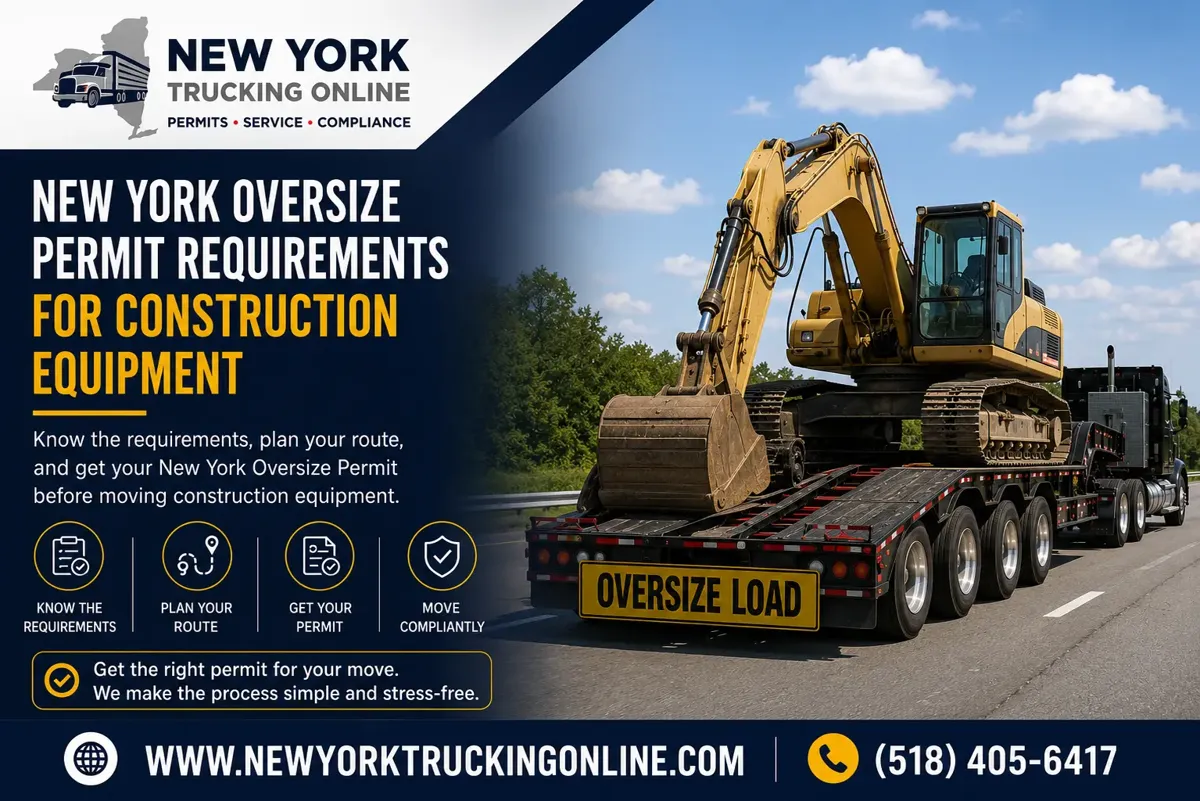
New York Oversize Permit Requirements For Construction Equipment
Table of Contents
-
Introduction
-
When Is A New York Oversize Permit Required?
-
Construction Equipment That Commonly Requires A Permit
-
Information You'll Need Before Applying
-
Route Planning And Travel Restrictions
-
Common Mistakes To Avoid
-
Why Many Trucking Companies Choose Our Service
-
FAQ
Introduction
Moving construction equipment throughout New York requires more than simply loading machinery onto a trailer and heading to the job site. Many types of equipment exceed the state's legal size or weight limits, making a New York Oversize Permit an important part of the transportation process. Whether you're hauling an excavator, bulldozer, crane, or another large machine, understanding the permit requirements before your trip can help prevent delays and keep your project on schedule.
Every oversized move presents unique challenges. Equipment dimensions, axle weights, travel routes, bridge clearances, and roadway restrictions all play a role in determining whether a permit is required and what conditions must be followed during transport. Planning ahead gives carriers more time to gather the necessary information and avoid last-minute complications.
This guide explains the basic New York Oversize Permit requirements for transporting construction equipment and shares practical tips to help you prepare for a successful move.
When Is a New York Oversize Permit Required?
A New York Oversize Permit is generally required whenever a vehicle or its non-divisible load exceeds the state's legal size or weight limitations. Construction equipment often falls into this category because many machines are designed as complete units and cannot be reasonably dismantled without affecting their intended purpose.
Examples of construction equipment that frequently requires a permit include:
-
Hydraulic excavators
-
Bulldozers
-
Wheel loaders
-
Motor graders
-
Backhoes
-
Self-propelled cranes
-
Asphalt paving machines
-
Milling machines
-
Drilling equipment
-
Large compactors
Whether a permit is required depends on several factors, including the equipment's overall height, width, length, gross weight, axle configuration, and the route being traveled. Each permit application is reviewed individually to determine the safest operating conditions for the move.
Obtaining the appropriate permit before transporting oversized construction equipment helps carriers remain compliant while reducing the risk of delays caused by incomplete paperwork or incorrect routing.
Construction Equipment That Commonly Requires A Permit
Construction equipment varies greatly in size, but many machines exceed legal highway dimensions even when transported on specialized trailers.
Some of the most commonly permitted loads include:
-
Excavators with large booms
-
Bulldozers with wide blades
-
Wheel loaders
-
Crawler loaders
-
Motor graders
-
Asphalt pavers
-
Road rollers
-
Mobile cranes
-
Concrete pump trucks
-
Large generators used on construction sites
Many of these machines qualify as non-divisible loads because separating them into smaller components would either damage the equipment or prevent it from performing its intended function. As a result, carriers often need an oversize permit before transporting them through New York.
Because every machine has different dimensions and weight characteristics, carriers should verify measurements before beginning the permit application process.
Information You'll Need Before Applying
Preparing accurate information before applying can help reduce processing delays and improve the accuracy of your permit application.
Most applications require details such as the following:
-
Vehicle information
-
Trailer configuration
-
Overall vehicle height
-
Overall width
-
Overall length
-
Gross vehicle weight
-
Individual axle weights
-
Axle spacing
-
Description of the construction equipment
-
Origin and destination
-
Proposed travel route
Taking accurate measurements is especially important. Even small errors can affect routing decisions or require corrections before a permit can be issued.
It's also helpful to review your application carefully before submission to confirm that every detail matches the equipment you plan to transport.
Route Planning And Travel Restrictions
Proper route planning is one of the most important parts of transporting oversized construction equipment.
New York's roadway system includes bridges, overpasses, weight-restricted highways, and local roads that may not accommodate certain oversized loads. During the permit review process, the proposed route is evaluated to determine whether it is appropriate for the dimensions and weight of the equipment being transported.
Depending on the characteristics of your load, your permit may include operating conditions such as
-
Approved travel routes
-
Authorized travel times
-
Escort vehicle requirements
-
Speed limitations
-
Holiday or weekend travel restrictions
-
Bridge crossing instructions
Following the approved route is essential. Deviating from permit conditions without authorization may create compliance issues and could require a new permit depending on the circumstances.
Reviewing your permit carefully before beginning your trip helps ensure you understand every condition associated with your move.
Common Mistakes To Avoid
Many permit delays occur because applications contain avoidable errors. Spending a few extra minutes reviewing your information before submission can help save valuable time.
Common mistakes include:
-
Incorrect equipment dimensions
-
Inaccurate axle weight information
-
Missing vehicle details
-
Incomplete route information
-
Typographical errors
-
Selecting the wrong trailer configuration
-
Waiting until the last minute to apply
Maintaining organized equipment records and measuring each load carefully before submitting an application can help reduce these problems.
If your equipment or travel plans change after submitting an application, review your permit requirements before beginning your trip to determine whether updates may be necessary.
Why Many Trucking Companies Choose Our Service
Applying for a New York Oversize Permit requires careful attention to equipment details, routing information, and application accuracy. At New York Trucking Online, we help trucking companies obtain New York Oversize Permits, Trip Permits, Fuel Permits, and other trucking credentials through a straightforward online process.
Our experienced team works with carriers to prepare accurate applications, answer permit-related questions, and help minimize delays. Whether you're transporting a single piece of construction equipment or coordinating multiple oversized moves, we strive to make the permitting process simple, efficient, and reliable so you can focus on your business.
FAQ
Does every piece of construction equipment require a New York Oversize Permit?
No. A permit is generally required only when the transported equipment exceeds New York's legal size or weight limits.
What types of equipment most commonly require oversize permits?
Excavators, bulldozers, cranes, graders, loaders, asphalt pavers, rollers, and other large construction machines frequently require permits.
Why are accurate measurements important?
Accurate dimensions and weights help determine the appropriate route, operating conditions, and permit requirements for your load.
Can my permit include travel restrictions?
Yes. Depending on your load, your permit may specify approved routes, travel times, escort vehicle requirements, and other operating conditions.
Can New York Trucking Online help with oversize permits?
Yes. New York Trucking Online assists carriers with New York Oversize Permits, Trip Permits, Fuel Permits, and other trucking permit services to help simplify the application process.