1. What Is a Trip Permit in New York?
-
In New York, a trip permit (also called a trip certificate of registration) is used by carriers that occasionally operate commercial vehicles in NY but don’t want to fully register for the Highway Use Tax (HUT).
-
This permit lets the carrier avoid filing HUT returns and paying highway use tax for the permitted period.
-
However, it doesn’t replace all permits: for example, it does not substitute an Automotive Fuel Carrier (AFC) permit if your vehicle hauls fuel.
2. When You Need a Trip Permit
You typically need a trip permit if:
-
You are a non–New York-based carrier that only occasionally makes trips into NY.
-
Your vehicle is subject to HUT (i.e., over a certain GVW). According to NY tax rules, many commercial trucks are subject to this.
-
You don’t want to register permanently in NY and pay HUT continuously.
But: If you are registered under IRP (International Registration Plan) or have a permanent HUT permit/sticker, you may not need a trip permit for temporary trips.
Also, note: you cannot exceed legal vehicle weight limits just by having a trip permit — the permit does not override weight laws.
3. Validity (How Long It Lasts)
-
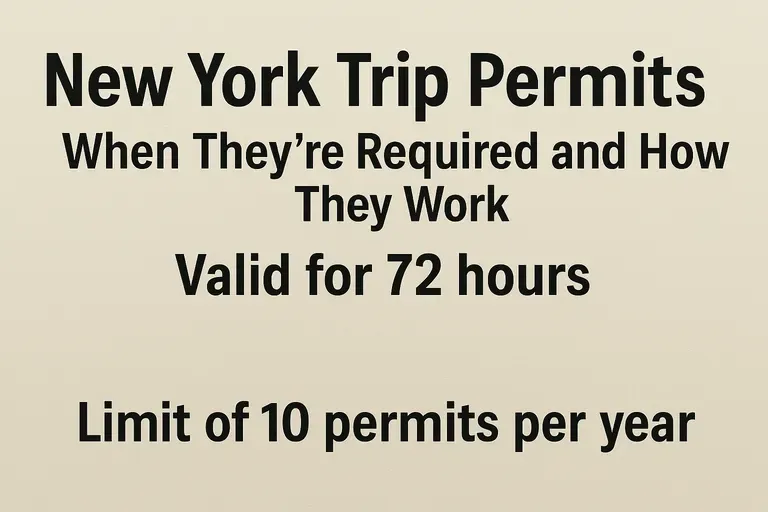
The NY trip permit is valid for 72 hours (3 calendar days) from its issuance time.
-
This 72-hour period does not get extended by weekends (Saturdays, Sundays) or public holidays — the permit simply ends when that 72-hour window is up.
-
Carriers can’t apply for unlimited permits: according to regulation, no more than 10 trip permits (trip certificates) may be obtained in a calendar year.
4. Cost / Fees
-
The standard fee for a New York trip permit is US $125 per permit.
-
Payment for the permit application must be via certified check, money order, or other guaranteed draft acceptable to the NY Department of Taxation & Finance.
5. How to Apply for a Trip Permit
-
You can apply 30 days in advance of the trip through www.newyorktruckingonline.com
-
Applications are made on a form prescribed by the NY Department of Taxation & Finance.
-
The application must list: carrier name, address, vehicle identification (VIN), and the starting date/time for the 72-hour period.
-
Once approved, you will receive a trip certificate (permit), which you must carry in the vehicle during the trip.
-
You also need to keep a copy of the permit in your records for at least 4 years — this is important for proving you were exempt from HUT during that time.
6. Key Restrictions & Considerations
-
Using a trip permit to evade regular HUT obligations can lead to permit revocation and penalties.
-
The permit doesn’t authorize you to violate weight or dimension limits — separate permits (e.g., special hauling permits) are needed for oversize or overweight loads.
-
You can’t use a trip permit for vehicles carrying automotive fuel: for them, a trip certificate is not available.
-
For very heavy or oversized loads, NYDOT’s Special Hauling Permits are required.
7. Penalties for Non-Compliance
-
If you operate without a valid trip permit when required, you risk fines or other enforcement action.
-
Permits can be denied, suspended, or revoked if you’ve violated NY Tax Law (e.g., failed to file HUT returns in the past).
-
Misuse of trip permits (such as using them repeatedly instead of proper HUT registration) can lead to more serious consequences.
8. Practical Tips for Carriers
-
Plan ahead: Apply for the trip permit well before your trip, especially if you are using the mail-in method.
-
Estimate your trip duration realistically: make sure 72 hours covers your expected in-state time.
-
Use a permit service if you want convenience — but check their fees, as they add on top of the base cost.
-
Carry the permit in the vehicle and have a copy in your records.
-
Track how many trip permits you use per year (max 10), and evaluate whether a permanent HUT permit / registration would be more cost-effective if you're making frequent trips.