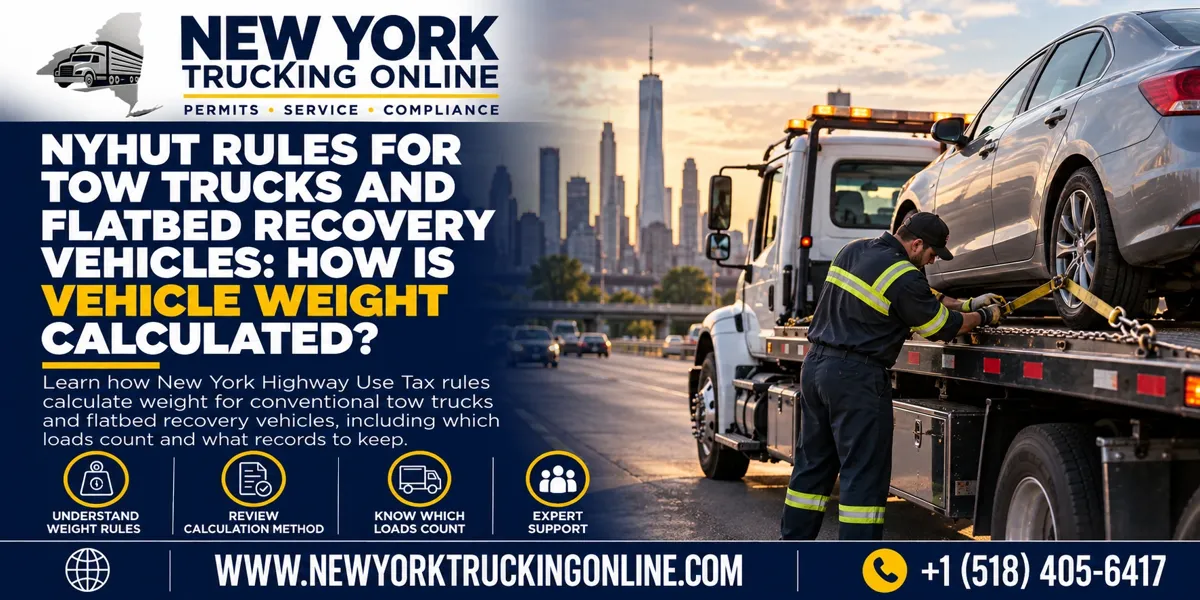
NYHUT Rules for Tow Trucks and Flatbed Recovery Vehicles: How Is Vehicle Weight Calculated?
Table Of Contents
-
Introduction
-
Why Vehicle Type Matters
-
Conventional Tow Truck Weight Calculations
-
Flatbed Recovery Truck Weight Calculations
-
Understanding Unloaded Weight
-
Choosing a Reporting Method
-
Common Mistakes to Avoid
-
Why Many Trucking Companies Choose Our Service
-
FAQ
Introduction
Tow trucks and flatbed recovery vehicles can look similar, but New York's Highway Use Tax rules do not always treat their loads the same way. How a disabled vehicle is transported can affect the weight used to calculate the New York Highway Use Tax (NYHUT).
The key distinction is whether the recovered vehicle is being towed on its own wheels or carried on a flatbed. Understanding this difference helps carriers document vehicle weight correctly and avoid relying on the wrong calculation.
Why Vehicle Type Matters
The New York Highway Use Tax is generally calculated using taxable miles traveled on New York public highways and a rate based on vehicle weight and the reporting method selected. Toll-paid portions of the New York State Thruway are excluded from the mileage calculation.
In general, the rules cover trucks with a gross weight over 18,000 pounds, trucks with an unloaded weight over 8,000 pounds, and tractors with an unloaded weight over 4,000 pounds, subject to applicable exclusions and exemptions. Carriers should check whether their vehicle and operation are subject to the tax.
For recovery businesses, the main question is how the disabled vehicle is being transported.
Conventional Tow Truck Weight Calculations
Under the gross-weight method, gross weight generally includes the unloaded weight of the truck, the unloaded weight of the heaviest trailer or other device it draws, and the maximum load it can carry or draw.
New York provides a specific rule for tow trucks: the weight of a vehicle being towed partly or wholly on its own wheels is excluded from the tow truck's gross-weight calculation. Therefore, carriers should not automatically add the full weight of a disabled vehicle being towed behind the truck as if it were cargo carried on the truck.
The tow truck's own weight and applicable equipment still matter. The driver and helpers are excluded from gross weight. Keep records that show the recovery setup, and confirm how the state rule applies if the configuration is unusual.
Flatbed Recovery Truck Weight Calculations
A flatbed tow truck carries the recovered vehicle on its bed instead of allowing it to roll on its own wheels. New York specifically requires the gross weight of a flatbed tow truck to include the weight of the heaviest vehicle being transported on the bed.
When determining gross weight, consider the flatbed truck's unloaded weight and the heaviest vehicle it transports. Do not calculate the truck as though it were empty simply because it is not pulling a conventional trailer.
Keep reliable records of the flatbed's specifications and the heaviest vehicle it may carry. If the right figure is unclear, check the New York State Department of Taxation and Finance's instructions or ask a qualified permit provider.
Understanding Unloaded Weight
New York also allows an unloaded-weight reporting method. Unloaded weight is the vehicle's actual weight, including qualifying equipment needed for operation and safety, permanently attached equipment, equipment used exclusively to protect the load, loading or unloading equipment, and full fuel tanks used to propel the vehicle. The driver and helpers are not included.
For recovery vehicles, permanently installed equipment can affect unloaded weight. Keep weight records current when equipment is added, removed, or replaced. Avoid relying only on a manufacturer's base weight if the truck has additional installed equipment.
Choosing a Reporting Method
A carrier selects either the gross-weight method or the unloaded-weight method when filing its first return for the calendar year. The selected method must be used for all its vehicles during that year and generally cannot be changed until the following year.
Under the gross-weight method, New York provides straight-line and heaviest-weight options with different rules for applying weight to laden and unladen miles. Review the current state instructions and choose the method that best matches the business's operations.
Maintain records for vehicle configuration, installed equipment, weight information, and miles traveled on New York public highways. Also document whether recovered vehicles are towed on their wheels or transported on a flatbed. If equipment or the types of recovery jobs change, review the figures rather than assuming old records remain accurate.
Common Mistakes to Avoid
Do not assume all recovery vehicles use the same gross-weight calculation. A conventional tow truck and a flatbed can be treated differently.
Do not include a towed vehicle's weight when the conventional tow-truck exclusion applies, or omit the heaviest carried vehicle's weight from a flatbed calculation. Remember qualifying equipment and full fuel tanks when determining unloaded weight, and do not switch reporting methods midyear without confirming the rules.
Why Many Trucking Companies Choose Our Service
New York Trucking Online helps carriers navigate registration and permit applications and organize the information needed for New York operations. Clear guidance can save time, reduce paperwork confusion, and help prevent delays caused by incomplete or inconsistent application details.
Our service provides practical permit assistance and customer support so trucking companies can manage administrative tasks more efficiently. For questions about a particular recovery setup, verify the official tax guidance before filing.
FAQ
Does a conventional tow truck include the towed vehicle's weight in gross weight?
Generally, no. New York excludes a vehicle's weight when it is being towed partly or wholly on its own wheels.
Does a flatbed tow truck include the vehicle carried on its bed?
Yes. The gross-weight calculation must include the heaviest vehicle being transported on the bed.
Are the driver and helpers included in the vehicle weight?
No. New York's gross-weight and unloaded-weight definitions exclude the driver and helpers.
Can a carrier change its NYHUT calculation method during the year?
No. The selected method applies to all the carrier's vehicles for the calendar year and generally cannot be changed until the following year.
What records should a recovery company keep?
Keep vehicle and equipment weight details, mileage records, and documentation showing how recovered vehicles are transported. Check with the state tax department if the correct treatment is unclear.
For more information, visit the New York State Department of Taxation and Finance.