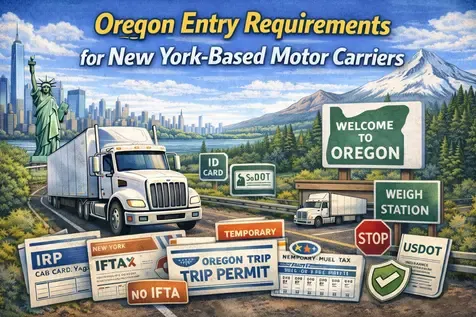
For Oregon Trip and Weight Mile Tax Permits visit - https://www.oregontruckingonline.org/
1. USDOT Number & Federal Authority
If your New York carrier operates interstate (crossing state lines), you must have a USDOT number issued by the FMCSA for commercial vehicles with a gross vehicle weight over 10,000 lbs. That stays with your truck as a basic federal safety and identification credential.
2. IRP Registration or Oregon Trip Permits
IRP (International Registration Plan)
-
You should ideally have your vehicles IRP‑registered and apportioned, including Oregon on the cab card if you plan to operate regularly in the state.
Out‑of‑State Trip Permits
-
If your New York‑based truck isn’t IRP‑registered for Oregon, you must obtain a temporary Oregon trip permit before operating in the state.
-
These permits typically last 10 consecutive days and cover registration requirements for a temporary visit.
-
Various types include:
• Heavy motor vehicle trip permit (for vehicles >10,000 lbs)
• Heavy trailer trip permit (for trailers registered outside Oregon)
• Temporary pass permits for weight‑mile tax compliance
3. Weight‑Mile Tax (Oregon Highway Use Tax) at https://www.oregontruckingonline.org/
Oregon does not participate in IFTA fuel tax; instead, heavy vehicles must comply with Oregon’s Weight‑Mile Tax (also called the highway use tax).
-
Vehicles over 26,000 lbs GVW must enroll in the Oregon Weight‑Mile Tax program or obtain a temporary weight‑distance permit before operating within the state.
-
Temporary weight‑distance permits allow compliance without a full permanent account for short trips.
4. IFTA Fuel Permits
-
Since Oregon doesn’t require or issue an Oregon IFTA license for out‑of‑state carriers, New York carriers typically use a temporary fuel permit in lieu of IFTA when operating there.
-
This fuel permit covers fuel tax obligations for a limited period (normally the same 10‑day span as other temporary permits).
5. Ports of Entry & Compliance Checks
-
Oregon has Ports of Entry and weigh stations where any commercial vehicle must stop unless bypass privileges apply.
-
Officers may check:
• USDOT number
• Valid permits (trip, fuel, weight‑mile/temporary pass)
• Vehicle registration and insurance
• Oversize/overweight permits if applicable
6. Insurance & Safety Documents
-
Carry proof of commercial liability insurance and basic safety documentation in the vehicle.
-
Even if your New York authority and insurance satisfy FMCSA federal standards, enforcement officers may check paperwork at weigh stations.
7. Oversize & Overweight Loads
-
If your convoy has loads exceeding Oregon’s legal size and weight limits, you need oversize/overweight permits before entry via Oregon’s permit system.
8. Recordkeeping
-
Keep accurate mileage, trip, and permit records, especially if paying weight‑mile taxes or using temporary permits.
-
These records may be audited and should be kept at your company location for at least three years.
Summary Checklist for New York Carriers Entering Oregon
Before Entry
Valid USDOT number
IRP apportioned registration (if regular operations) or Temporary Oregon Trip/Fuel/Weight‑Mile permits
Temporary fuel permit (if not IFTA)
Insurance documentation
At Weigh Stations/Entry
Present permits and cab cards
Comply with stop and inspection requirements
Optional (If Applicable)
Oversize/overweight permits
Local/city permits for urban access
Bottom Line
New York‑based carriers can legally operate in Oregon, but the state’s system requires planning ahead: secure trip and fuel permits or a proper IRP/Weight‑Mile Tax account before entry, carry all credentials like USDOT and insurance, and prepare for weigh station compliance. Operating without the right permits in Oregon can lead to citations, fines, or delays at Ports of Entry.
https://www.oregon.gov/odot/mct/pages/oregon-motor-carrier-requirements.aspx