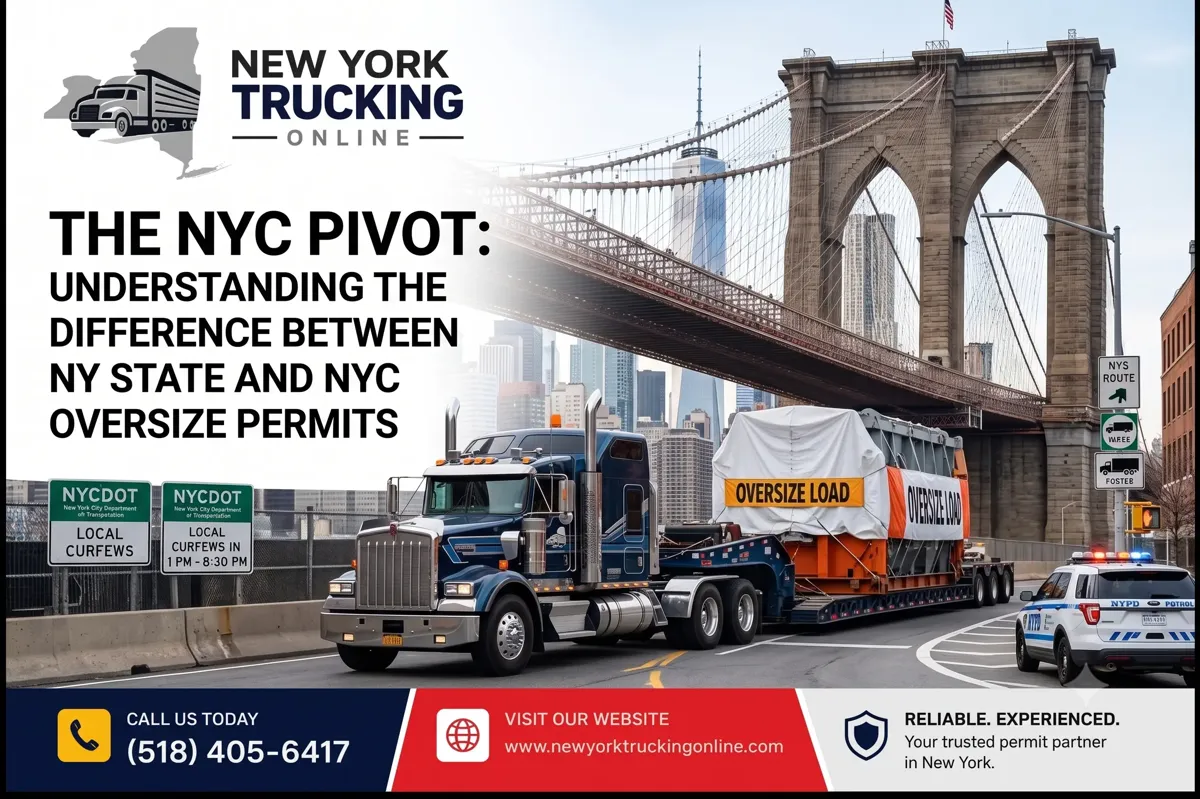
The NYC Pivot: Understanding the Difference Between NY State and NYC Oversize Permits
Running an oversized or heavy load through New York can be one of the most profitable routes for a trucking company. It can also be a compliance nightmare if you do not understand how local jurisdictions work.
Many carriers make a costly mistake: they assume that obtaining a standard New York State oversize permit covers their entire journey from the border to their destination. However, if your route takes you into any of the five boroughs of New York City, that state-level permit is no longer enough. The city operates under its own distinct set of rules, agencies, and restrictions.
Crossing into New York City requires a completely different strategy—what experienced heavy haulers call "the NYC pivot." This guide breaks down the core differences between New York State and New York City oversize permits, when you need them, and how to stay legal without losing time or money.
Table of Contents
-
The Baseline: Legal Size and Weight Limits in New York
-
New York State Permits vs. New York City Permits
-
Understanding the Strict Rules of the Five Boroughs
-
Managing Temporary Trip, Fuel, and Tax Registrations
-
Why Many Trucking Companies Choose Us
-
Frequently Asked Questions (FAQ)
The Baseline: Legal Size and Weight Limits in New York
Before diving into the differences between the city and the state, it is important to understand what triggers the need for a permit in the first place. For most roads across the state, a commercial vehicle is considered legal if it stays within these standard boundaries:
-
Width: 8 feet, 6 inches
-
Height: 13 feet, 6 inches
-
Gross Weight: 80,000 pounds
If your truck or cargo exceeds any of these dimensions, you must secure special authorization before moving. Operating without the right paperwork can result in massive delays, impounded equipment, and structural safety hazards.
New York State Permits vs. New York City Permits
The fundamental difference between these two authorizations comes down to jurisdiction.
-
New York State DOT Permits: These are issued by the state government and cover state highways, interstates, and routes outside of New York City. A standard state-level single-trip permit is usually valid for five days of travel.
-
New York City DOT Permits: The New York City Department of Transportation controls the roads, bridges, and expressways within Manhattan, Brooklyn, Queens, the Bronx, and Staten Island. A state permit does not grant permission to travel on these city-managed roads.
Furthermore, while a state permit covers a multiday window, a New York City oversize permit is strictly good for a single move during a specific time frame. In fact, if you are delivering a load into the city and then driving the empty, oversized trailer back out, you generally need two separate city permits: one to get in and one to get out.
Understanding the Strict Rules of the Five Boroughs
New York City has some of the most congested streets and lowest historic bridges in the country. Because of this, the city enforces much stricter rules than the rest of the state.
-
Tunnels and Bridges: Many iconic crossings have severe height limits. For instance, loads over 12 feet, 1 inch tall cannot enter city tunnels. Certain bridges completely ban overweight or oversized commercial vehicles due to structural weight limits.
-
Time Curfews: While the state allows daytime travel on many routes, the city frequently forces oversized loads to move strictly at night or during off-peak windows to avoid crippling gridlock.
-
Route Surveys: The threshold for requiring a professional route survey is lower in the city. A load that is 12 feet wide requires a route survey in NYC, whereas the state allows slightly wider movements before triggering that mandate.
Managing Temporary Trip, Fuel, and Tax Registrations
Oversized dimensions are only one part of the New York compliance puzzle. Out-of-state carriers must also ensure their tax and fuel accounts are active before entering the state boundaries.
If your trucks do not frequently travel through the state, maintaining permanent accounts can be a paperwork burden. That is where temporary options become essential:
-
NYHUT Requirements: New York imposes a Highway Use Tax (HUT) on commercial vehicles exceeding certain weight thresholds. If you do not have a permanent NYHUT account and decal, you must obtain a temporary trip permit for NY to remain legal.
-
Fuel Taxes: If your vehicle is not registered under the International Fuel Tax Agreement (IFTA), you will need a NY fuel permit (also called a temporary fuel trip permit) to account for the fuel used while driving on New York roads.
-
Getting Set Up Online: Utilizing an online NY trip permit service allows you to secure a temporary NY trip permit and a NY trip permit simultaneously. This ensures that when your driver reaches the state line, both their size authorizations and their NY temporary registration bases are completely covered. Checking the State of New York trip check protocols beforehand ensures no unexpected stops at the weigh stations.
Why Many Trucking Companies Choose Us
Navigating the overlapping rules of state permits, city curfews, NYHUT filings, and temporary fuel authorizations takes time that busy fleet managers and owner-operators simply do not have. One missing piece of paper can stall a high-value delivery for days.
At New York Trucking Online, we focus on making the permit process clear, fast, and reliable. Instead of spending hours trying to figure out which office handles which bridge, or waiting on hold to resolve a temporary registration issue, you can submit your load details to us. Our team handles the specific paperwork tracking for both New York State and New York City compliance, delivering the correct documents directly to your inbox so your drivers can stay focused on the road.
Frequently Asked Questions (FAQ)
Can I use a 53-foot trailer in New York City?
Standard 53-foot trailers are only legal on specific designated interstate segments within New York City limits (such as parts of I-95, I-295, and I-495). If your route requires exiting these designated truck routes onto local city streets, you will need a special city permit.
How long is a temporary NY trip permit valid?
A temporary registration or trip permit typically covers a specific, short-term window (usually 72 hours) to allow an out-of-state truck to enter, complete its delivery, and exit the state legally without maintaining a permanent HUT registration.
What happens if I enter NYC with only a New York State DOT permit?
If you cross into the five boroughs without a distinct New York City DOT permit for an oversized load, you risk severe local fines, which can easily reach thousands of dollars, alongside having the truck grounded until the correct city permits are obtained.