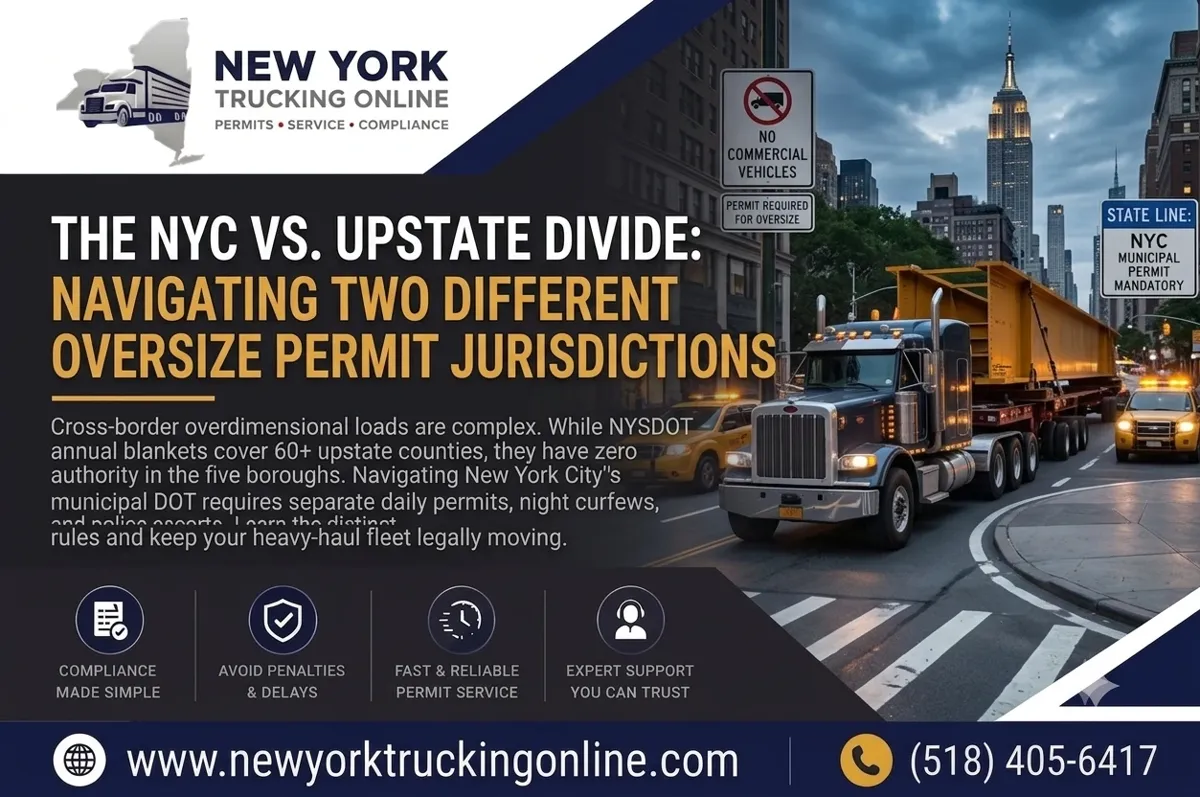
The NYC vs. Upstate Divide: Navigating Two Different Oversize Permit Jurisdictions
Table of Contents
-
Introduction
-
The Structural Split: NYSDOT vs. NYC DOT
-
Understanding the Legal Limits for Both Jurisdictions
-
Key Rule Differences: Escorts, Curfews, and Routing
-
The Hidden Trap of Statewide "Blanket" Permits
-
How to Avoid Costly Fines and Route Delays
-
Why Many Trucking Companies Choose Our Service
-
Frequently Asked Questions
Introduction
Moving a standard commercial shipment across New York State requires careful routing and timing. However, when your freight is classified as oversize or overweight (OS/OW), the administrative planning becomes far more intense. Many heavy haulers assume that securing a standard state permit is enough to legally transport their load from the Canadian border all the way down to a construction site in Brooklyn.
Unfortunately, this assumption is a costly mistake.
New York is one of the most uniquely regulated states in the nation when it comes to overdimensional freight. It is split into two entirely separate legal jurisdictions: Upstate New York (regulated by the state) and New York City (regulated by the city itself). Crossing the boundary between these two territories without the correct, separate paperwork can result in immediate vehicle impoundment, halted operations, and tens of thousands of dollars in municipal fines.
Understanding the differences between upstate and downstate rules is vital to keeping your fleet running legally and on schedule.
The Structural Split: NYSDOT vs. NYC DOT
When you move an oversized load through the vast majority of New York State, you deal directly with the New York State Department of Transportation (NYSDOT). They oversee state-owned highways, determine bridge weight capacities outside of metropolitan areas, and issue standard special hauling permits.
However, the moment your truck crosses into the five boroughs of New York City (the Bronx, Brooklyn, Manhattan, Queens, and Staten Island), state authority stops.
At the city line, jurisdiction shifts entirely to the New York City Department of Transportation (NYC DOT). The city maintains its own dedicated, local "daily over-dimensional permit" system. If you travel on any roadway, expressway, or bridge managed by NYC, you must carry an authorized city-issued permit. Because both agencies operate independently, a permit from NYSDOT carries absolutely zero legal authority on city streets and vice versa.
Understanding the Legal Limits for Both Jurisdictions
Before planning any heavy-haul or wide-load route through New York, you need to understand where the legal "trigger limits" lie. The thresholds that dictate when you must transition from a standard truck registration to an oversize permit differ between the state and the city:
-
Upstate New York (NYSDOT) Thresholds: You require an upstate permit if your vehicle or load exceeds 8 feet 6 inches in width, 13 feet 6 inches in height, 65 feet in overall combination length, or 80,000 pounds in gross vehicle weight.
-
New York City (NYC DOT) Thresholds: NYC enforces incredibly tight physical boundaries due to its historic infrastructure, low parkway overpasses, and dense traffic. A city overdimensional permit is required if your setup exceeds 8 feet 0 inches in width, 13 feet 6 inches in height, or standard city length parameters.
Even a trailer that is exactly 8 feet 6 inches wide is fully legal on standard highways upstate; technically, it requires local city authorization the moment it enters NYC municipal limits.
Key Rule Differences: Escorts, Curfews, and Routing
Obtaining the permits is only half the battle; complying with their respective operating conditions is where many dispatchers struggle. The differences in travel restrictions between NYSDOT and NYC DOT are stark:
Travel Windows and Curfews
-
Upstate (NYSDOT): Generally allows permitted loads to travel from Monday through Friday, starting 30 minutes before sunrise until 30 minutes after sunset. Limited Saturday morning movement is allowed for smaller loads, while Sunday travel is strictly prohibited.
-
New York City (NYC DOT): Due to severe daytime traffic congestion, daytime movement for large, permitted loads is virtually nonexistent. Most NYC permits restrict overdimensional travel strictly to night hours (typically between 10:00 PM and 6:00 AM) or demand highly specific off-peak routing.
Pilot Cars and Escort Requirements
-
Upstate (NYSDOT): Standard pilot car or certified escort triggers are based on moderate width and length metrics. Escort requirements scale gradually as your load size increases.
-
New York City (NYC DOT): Because of narrow urban corridors and tight turns, NYC has its own complex escort rules. Often, a load that requires only one pilot car upstate will require multiple escorts, or even a mandatory New York State Police or NYPD escort, to safely block lanes in the city.
The Hidden Trap of Statewide "Blanket" Permits
For carriers that move heavy equipment or wide structures frequently, NYSDOT offers convenient annual "blanket" permits. These annual documents are fantastic for saving administrative time and cutting down on per-trip fees.
However, many dispatchers fall into a dangerous trap, assuming a "statewide annual permit" gives them blanket access to the entire state.
It is vital to remember that state-issued annual permits are not valid in New York City. Even if you possess an active NYSDOT annual permit, you must still apply for and secure a separate local, single-trip daily permit from NYC DOT every single time you plan to cross into the city boundaries.
How to Avoid Costly Fines and Route Delays
Operating a heavy-haul truck in New York without the correct dual-jurisdiction permits raises massive liability issues. Fines for unauthorized travel on municipal city roads can easily escalate from a few hundred dollars to tens of thousands of dollars. Worse, if an unpermitted load strikes a low bridge or is involved in an accident, your insurance company may deny coverage, exposing your trucking business to severe legal damage.
To protect your business and keep your routes clear, follow these best practices:
-
Map Out Every Jurisdiction: Analyze your exact route from start to finish. Identify precisely where you exit NYSDOT roads and enter NYC DOT roads.
-
Order Permits Well in Advance: Because NYC DOT and NYSDOT use separate electronic filing systems, permit processing times vary. Do not wait until your driver is at the border to submit your applications.
-
Perform Route Surveys: Highly complicated or extremely tall loads should always utilize a pre-route survey to identify low-hanging utility wires, construction, and clearance issues before hitting the road.
Why Many Trucking Companies Choose Our Service
Navigating the bureaucratic divide between Albany's state systems and New York City's municipal regulations is incredibly complex. One wrong box checked on your application can lead to a rejected permit, stranded drivers, and missed delivery windows.
At New York Trucking Online, we cut through the red tape of both jurisdictions. We act as your single, reliable point of contact for all your New York permitting needs:
-
Dual-Jurisdiction Filing: We manage your applications for both NYSDOT and NYC DOT simultaneously, ensuring your paperwork is perfectly synchronized.
-
Expert Route Review: Our experienced compliance team reviews your vehicle dimensions and axle configurations to make sure your route is fully legal and safe.
-
Rapid Processing: We submit your files directly through the state and city databases, dramatically reducing processing delays so your trucks stay on the move.
Let us handle the administrative hassle so your drivers can focus on the road ahead.
FAQ
Does a New York State Thruway permit cover me in New York City?
No. The New York State Thruway Authority is yet another separate agency with its own permit system. A Thruway permit only covers travel on the physical I-87 and I-90 toll corridors. It does not cover travel on state highways (NYSDOT) or local NYC streets (NYC DOT).
What happens if I cross the NYC line with only an upstate NYSDOT permit?
If you are stopped by NYPD or commercial vehicle enforcement within the five boroughs, your upstate permit will be deemed invalid. You will face massive municipal fines, and your truck will be ordered out of service until a proper city permit is secured.
How long are NYC daily overdimensional permits valid?
Unlike standard NYSDOT single-trip permits, which may be valid for up to five hauling days, NYC daily overdimensional permits are highly time-specific and are generally issued on a per-trip or daily basis to coordinate with night-travel windows.