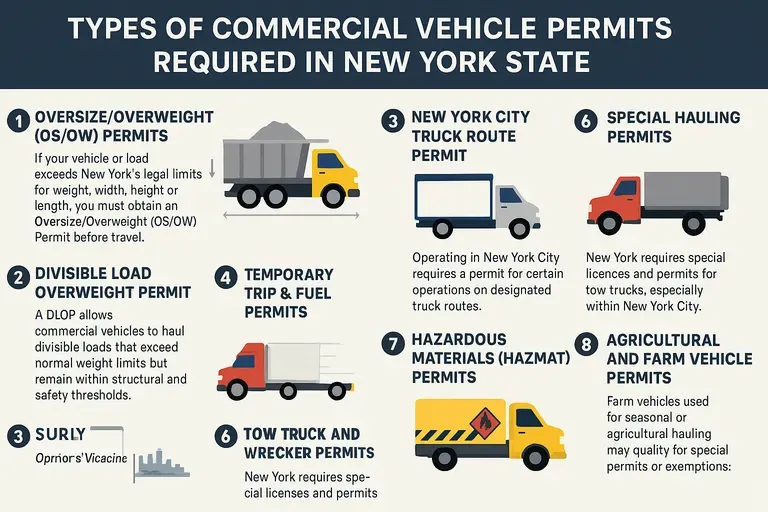
1. Oversize/Overweight (OS/OW) Permits
If your vehicle or load exceeds New York’s legal limits for weight, width, height, or length, you must obtain an Oversize/Overweight (OS/OW) Permit before travel.
Common legal limits:
-
Width: 8 feet 6 inches
-
Height: 13 feet 6 inches
-
Length: 40 feet (single vehicle), 65 feet (combination)
-
Weight: 80,000 lbs gross vehicle weight
Permit types:
-
Single-trip permit: For one-time moves on approved routes.
-
Annual permit: For repeated trips within a specific route or region.
-
Divisible load overweight permit (DLOP): For carriers moving loads that can be divided, like gravel or fuel.
Issuing Authority: New York State Department of Transportation (NYSDOT)
2. Divisible Load Overweight Permit (DLOP)
A DLOP allows commercial vehicles to haul divisible loads that exceed normal weight limits but remain within structural and safety thresholds.
Examples include:
-
Bulk commodities like sand, concrete, and asphalt
-
Utility vehicles carrying tools or repair materials
-
Fuel and tank trucks
Note: DLOP carriers must comply with axle spacing and tire width requirements and renew their permit annually through the New York State Automated Permitting System (NYSOPS).
3. New York City Truck Route Permit
Operating in New York City brings an additional layer of regulation. Trucks must use designated truck routes and may require permits for certain operations.
Required for:
-
Oversize or overweight trucks entering NYC limits
-
Construction vehicles operating within restricted zones
-
Deliveries requiring off-route access
Issuing Authority: New York City Department of Transportation (NYC DOT)
4. Special Hauling Permits
Special Hauling Permits apply to vehicles transporting non-divisible loads such as heavy machinery, bridge beams, or modular homes.
These permits often require:
-
Escort vehicles for oversized loads
-
Detailed route surveys to avoid low bridges or weak structures
-
Advance notice for local law enforcement or DOT coordination
Issued by: NYSDOT or NYC DOT depending on route jurisdiction.
5. Temporary Trip and Fuel Permits
Out-of-state carriers who don’t have an IRP (International Registration Plan) or IFTA (International Fuel Tax Agreement) account must purchase temporary permits to operate legally in New York.
-
Temporary Trip Permit: Covers registration for 72 hours.
-
Temporary Fuel Permit: Covers fuel tax reporting for 24 hours.
These permits allow short-term operations without full registration and are typically issued through www.newyorktruckingonline.com
6. Tow Truck and Wrecker Permits
New York requires special licensing and permits for tow trucks, particularly within New York City.
Includes:
-
Department of Consumer and Worker Protection (DCWP) Tow Truck License
-
Police Department Tow Zone Permits for contracted towing zones
Operating without proper authorization can lead to vehicle impoundment or license suspension.
7. Hazardous Materials (HazMat) Permits
Any vehicle transporting hazardous materials or waste within New York must comply with both federal DOT and state environmental regulations.
Requirements include:
-
Valid HazMat endorsement (HME) on CDL
-
State-issued transportation permit
-
Emergency response documentation onboard
8. Agricultural and Farm Vehicle Permits
Farm vehicles used for seasonal or agricultural hauling may qualify for special permits or exemptions under New York law.
These are typically limited to:
-
Vehicles transporting farm products within a 150-mile radius
-
Seasonal harvest permits during planting and harvest periods
Key Takeaway
New York’s trucking permit system ensures safe and efficient movement of goods while protecting roads and bridges from damage.
Before operating in the state, carriers should determine:
-
The type of vehicle and load being transported
-
Whether the route enters restricted areas (like NYC)
-
If the load qualifies as oversize, overweight, or hazardous
Obtaining the right permits not only prevents fines but also keeps your operation compliant and reliable.