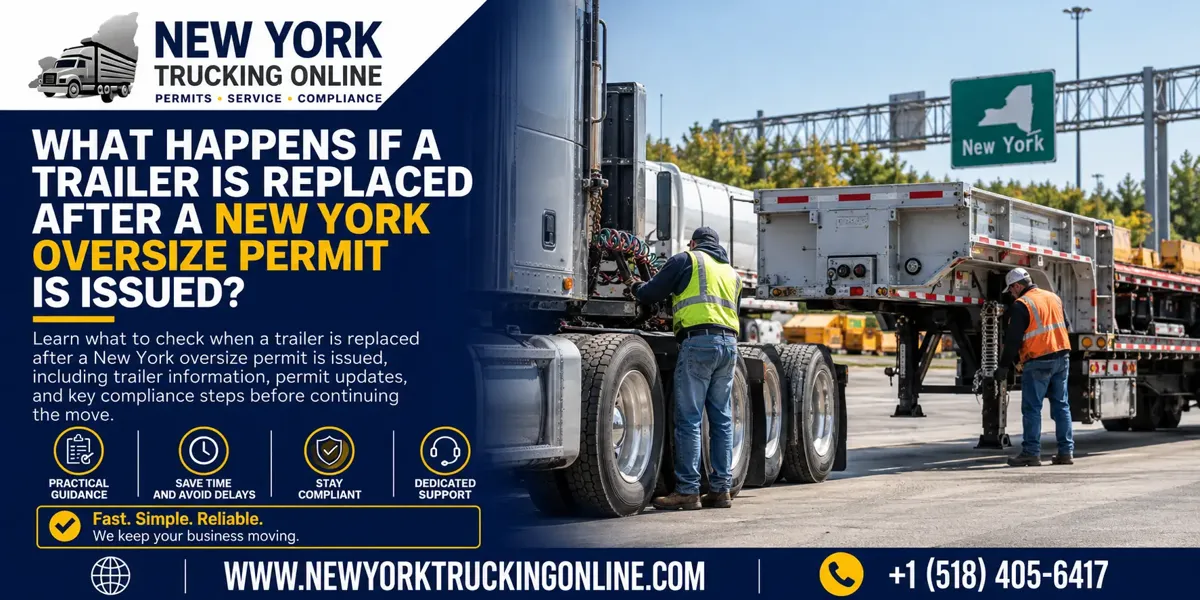
What Happens If A Trailer Is Replaced After A New York Oversize Permit Is Issued?
Table Of Contents
-
Introduction
-
Why The Trailer Matters On A New York Oversize Permit
-
What Happens If The Trailer Must Be Replaced?
-
Can The Existing Permit Still Be Used?
-
What Carriers Should Check Before Continuing
-
How To Avoid Permit Problems After A Trailer Replacement
-
Why Many Trucking Companies Choose Our Service
-
FAQ
Introduction
A trailer may need to be replaced after a New York Oversize Permit has already been issued. Mechanical problems, equipment damage, maintenance issues, or an unexpected equipment change can force a carrier to use another trailer before the permitted move is completed.
The important issue is that the replacement trailer may not automatically be covered by the original permit. New York requires trailers used under applicable overweight permits to be properly identified, and a trailer change can require the carrier to update the permit before the movement continues.
Why The Trailer Matters On A New York Oversize Permit
A New York Oversize Permit is tied to the permitted vehicle combination and the conditions of the authorized movement. Trailer information can include the trailer plate, configuration, axle characteristics, length, and other specifications that help identify the permitted combination.
Because of this, a trailer is not simply interchangeable equipment under an active permit. A different trailer can change the configuration of the combination, even when the tractor and load remain exactly the same.
This becomes particularly important for overweight movements. A replacement trailer can have different axle spacing, axle ratings, dimensions, or weight characteristics. Those changes may affect whether the existing permit still matches the equipment being used.
What Happens If The Trailer Must Be Replaced?
If the original trailer becomes unavailable, the carrier should review the permit before attaching the replacement trailer and continuing the move.
Start by collecting the replacement trailer's information. This may include the license plate, unit number, length, axle configuration, axle spacing, weight ratings, and other identifying details.
Then compare the replacement trailer with the trailer listed on the existing permit. If the information is different, the carrier should determine whether the permit needs to be amended or whether another authorization is required.
A trailer replacement should therefore be treated as a permit-review issue, not simply as an equipment swap. Continuing first and correcting the paperwork later can create unnecessary compliance problems.
Can The Existing Permit Still Be Used?
A carrier should not assume that an existing New York Oversize Permit automatically remains valid for a different trailer.
When the trailer changes, the carrier should review whether the replacement equipment can be added to the existing permit through the applicable process. The answer may depend on the type of permit, the trailer configuration, and the information originally submitted.
Do not cross out the old trailer information, write the replacement plate number onto the permit, or make other handwritten changes. The carrier should use the appropriate process for updating the permit information.
If the replacement trailer has a different configuration from the original, the review becomes even more important because the new equipment may affect axle spacing, weight distribution, or other conditions associated with the permitted movement.
What Carriers Should Check Before Continuing
When a trailer is replaced during an active permitted move, dispatch should review the complete permit package before the truck resumes travel.
Check the following:
-
Original permit number
-
Original trailer information
-
Replacement trailer license plate
-
Trailer unit number
-
Trailer length
-
Number of axles
-
Axle spacing
-
Axle ratings
-
Vehicle and load information
-
Authorized weights and dimensions
-
Approved route and permit conditions
The carrier should also confirm that the replacement trailer is appropriate for the load being transported. A different trailer can change the overall vehicle combination, so the carrier should not focus only on the trailer plate.
Before the driver continues, make sure the permit documentation accurately reflects the equipment being used.
How To Avoid Permit Problems After A Trailer Replacement
The easiest way to avoid problems is to make permit review part of the equipment-replacement process.
Keep the original New York Oversize Permit, trailer records, registration information, and equipment specifications together in dispatch files. If a trailer becomes unavailable, collect the replacement trailer's information before putting it into service for the permitted movement.
Carriers should also notify dispatch immediately when a trailer is changed. This gives the responsible person time to compare the new equipment with the permit and determine whether any update is required.
A quick review before the truck moves again can help prevent mismatched documentation, unnecessary delays, and problems during an inspection.
Why Many Trucking Companies Choose Our Service
New York Trucking Online gives trucking companies a straightforward way to manage permit applications without handling every administrative step on their own. Our service helps carriers save time, simplify permit processing, reduce paperwork, and avoid unnecessary delays when equipment changes affect an upcoming or active permitted move.
With fast processing, accurate permit assistance, and dedicated customer support, New York Trucking Online makes the permit process more convenient. Carriers can spend less time working through administrative details and more time focusing on drivers, equipment, scheduled loads, and transportation operations.
FAQ
Can I use the same New York Oversize Permit after replacing the trailer?
Do not assume that the existing permit automatically covers the replacement trailer. Review the trailer change and determine whether the permit must be updated before continuing the movement.
Does the replacement trailer need to match the original trailer?
Not necessarily, but any differences should be reviewed. Changes to the trailer's plate, dimensions, axle configuration, spacing, or weight characteristics can affect the permitted combination.
What information should I collect about the replacement trailer?
Collect the trailer plate, unit number, length, number of axles, axle spacing, axle ratings, and other equipment details needed to compare the replacement trailer with the permit.
Can I manually change the trailer information on the permit?
No. Do not cross out or rewrite permit information yourself. Use the appropriate process for updating the issued permit.
What if the replacement trailer has a different axle configuration?
A different axle configuration can affect the permitted vehicle combination. Review the new equipment before the trip continues and determine whether updated authorization is required.
For more information, visit the New York State Department of Transportation.