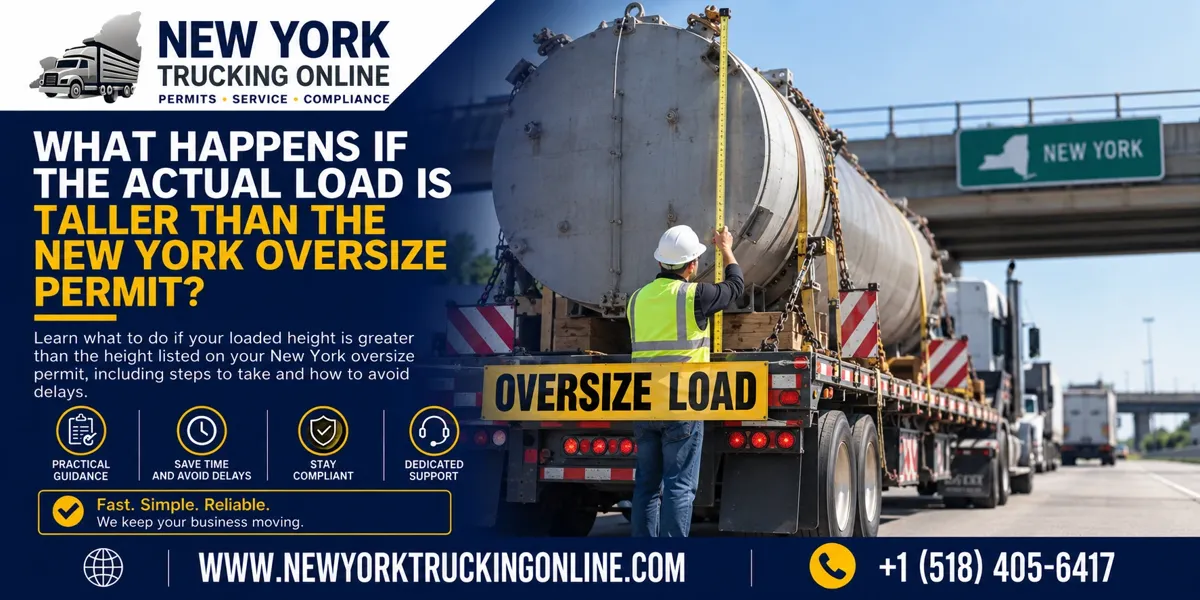
What Happens If The Actual Load Is Taller Than The New York Oversize Permit?
Table Of Contents
-
Introduction
-
Why The Actual Height Must Match The Permit
-
What To Do Before The Truck Starts
-
Can A Small Height Difference Be Ignored?
-
Why Extra Height Can Affect The Route
-
What If The Load Becomes Taller During Loading?
-
How To Prevent Height Errors
-
Why Many Trucking Companies Choose Our Service
-
FAQ
Introduction
When an oversize load is prepared for transportation, its final dimensions need to match the information used for the New York Oversize Permit. Height is especially important because additional inches can affect clearance at bridges, overpasses, signs, utility lines, and other structures along the approved route.
When the actual loaded height is greater than the height shown on the permit, the carrier should not simply begin the trip and assume that the difference is acceptable. The actual loaded dimensions should be verified, compared with the permit, and addressed before the movement begins.
Why The Actual Height Must Match The Permit
A New York Oversize Permit authorizes an oversize or overweight vehicle and load subject to the conditions stated on the permit. The permit is issued for a particular movement and vehicle configuration, so the dimensions used during the permitting process matter.
If the actual height exceeds the dimension authorized by the permit, the movement may no longer match the permitted configuration.
For example, suppose a permit lists an overall height of 14 feet, but the completed vehicle and load measure 14 feet 4 inches. The carrier should not assume that the additional four inches are automatically covered.
The actual measurement should be reviewed before the vehicle travels under the permit.
What To Do Before The Truck Starts
If the load is discovered to be taller than the permitted height while the truck is still at the pickup location, the carrier should pause the movement and verify the situation.
Start by measuring the complete vehicle and load again. The measurement should include the highest point of the completed loaded configuration rather than relying only on the cargo manufacturer's dimensions.
The carrier should then compare the measurement with the permit.
Check:
-
Permitted overall height
-
Actual overall height
-
Truck and trailer configuration
-
Load position
-
Route listed on the permit
-
Travel date
-
Special conditions
-
Any required route survey or escort provisions
If the actual height is greater than the permitted height, the carrier should determine whether the permit needs to be amended or whether different authorization is required.
The truck should not be dispatched until the discrepancy has been properly addressed.
Can A Small Height Difference Be Ignored?
A small difference should not automatically be treated as insignificant.
Height restrictions exist because clearance can vary from one location to another. A few additional inches may matter at a low bridge, railroad structure, overhead sign, utility line, or other point along the route.
A carrier should therefore verify the actual height and applicable requirements rather than deciding independently that a difference is too small to matter.
Why Extra Height Can Affect The Route
The route approved for an oversize movement is based partly on the dimensions of the vehicle and load.
A route that works for a shorter load may not necessarily be suitable for a taller one. Clearance becomes especially important when the load approaches or exceeds height restrictions along the route.
If the actual height changes, the carrier should not assume that the original route remains appropriate.
The driver should also avoid making an unapproved route change simply to accommodate the additional height. A different road may have its own clearance restrictions or permit conditions.
Before departure, the carrier should confirm that the actual loaded height and approved route still correspond.
What If The Load Becomes Taller During Loading?
Sometimes the problem is not discovered until the cargo is actually placed on the trailer.
A piece of equipment may sit higher than expected because of its position on the trailer, suspension height, loading method, or additional components attached during preparation.
For this reason, carriers should measure the complete loaded vehicle before departure.
The final measurement should be compared with the permit rather than relying only on measurements supplied before loading.
If the final height is greater than the permitted height, the carrier should stop the movement and determine what corrective action is necessary.
In some situations, repositioning or securing the cargo differently may reduce the final height. If the load remains taller than the permit allows, the carrier should address the permit before travel.
How To Prevent Height Errors
The best way to avoid a height discrepancy is to verify the measurement before the permit application and again after the load is secured.
Carriers can use a simple pre-dispatch checklist:
-
Measure the trailer before loading.
-
Confirm the cargo's actual dimensions.
-
Determine the highest point of the completed load.
-
Verify the loaded height after securement.
-
Compare the final measurement with the permit.
-
Confirm the route can accommodate the permitted height.
-
Review any height-specific permit conditions.
-
Make sure the driver has the correct permit before departure.
Why Many Trucking Companies Choose Our Service\
New York Trucking Online makes the permit process easier for trucking companies by assisting with permit applications and processing. Carriers can submit their information and receive support throughout the process, helping them avoid unnecessary confusion and save time when preparing for their trips.
Our service is designed to provide a straightforward experience for trucking companies that need reliable permit assistance. From preparing the required information to processing the request, we help carriers handle the administrative side of their trip so they can focus on their transportation operations.
FAQ
What happens if my load is taller than my New York Oversize Permit?
The carrier should not assume that the existing permit covers the greater height. The actual dimensions should be verified and the permit situation addressed before the movement begins.
Can I drive if the load is only a few inches taller than the permit?
A carrier should not assume that a small difference is acceptable. Even a small increase can affect clearance and potentially change the requirements for the movement.
Should I measure the load again after loading?
Yes. The final loaded height should be verified before departure because the cargo's position and configuration can affect the overall height.
Can I simply change the height written on the permit?
No. Carriers should not manually alter an issued permit. If the actual dimensions differ, the appropriate permitting process should be followed.
Can a taller load require a different route?
It can. Additional height can affect clearance and may require route review or additional requirements depending on the dimensions and route.
What if the load can be repositioned to reduce its height?
If repositioning the cargo results in a different final dimension, the carrier should verify the completed configuration and ensure that it complies with the applicable permit conditions before traveling.
For more information, visit the New York State Department of Transportation.