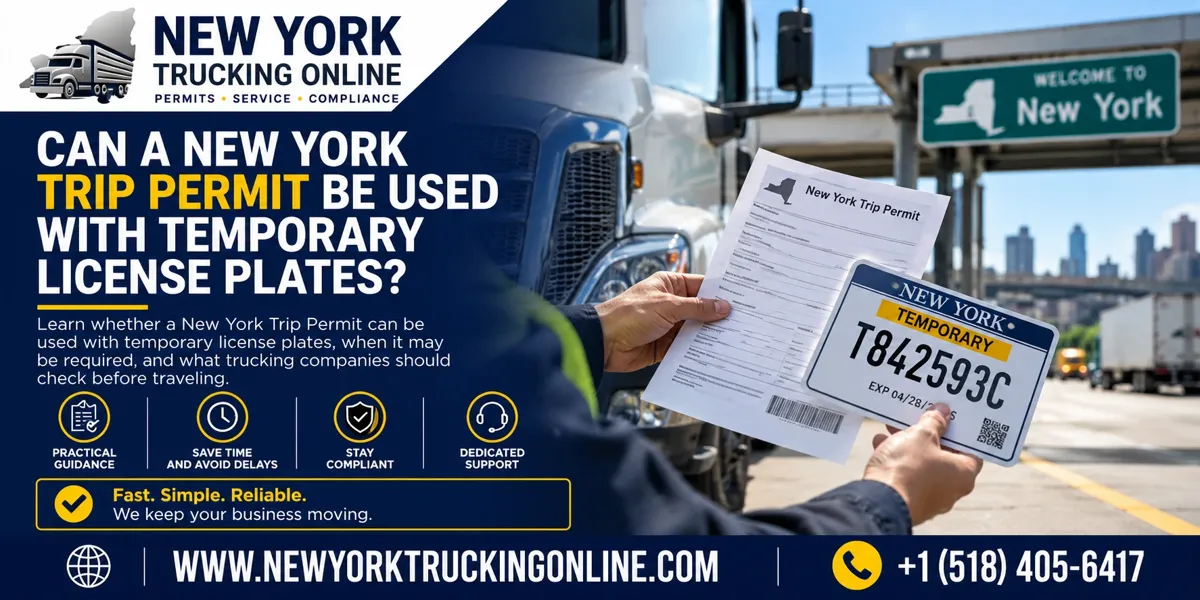
Can A New York Trip Permit Be Used With Temporary License Plates?
Table Of Contents
-
Introduction
-
How A New York Trip Permit Works
-
What Temporary License Plates Mean
-
Can Both Be Used Together?
-
When A New York Trip Permit May Still Be Needed
-
What Carriers Should Check Before Traveling
-
Why Many Trucking Companies Choose Our Service
-
FAQ
Introduction
Temporary license plates can be useful when a commercial truck is newly purchased, awaiting permanent registration, or operating under temporary registration documents. For carriers traveling into New York, however, a temporary plate does not automatically answer every registration or tax requirement.
This raises an important question: can a New York Trip Permit be used when a truck already has temporary license plates? The answer depends on the type of registration, the vehicle's operating status, and whether the truck needs temporary authority for New York. Understanding how the credentials work together can help carriers prepare the correct documents before the trip.
How A New York Trip Permit Works
A New York Trip Permit can refer to temporary authorization used by carriers that only occasionally operate certain commercial vehicles in New York. For vehicles subject to the Highway Use Tax, New York provides a trip certificate of registration as an alternative to obtaining a regular HUT certificate and decal when the vehicle only operates occasionally in the state.
For qualifying interstate commercial vehicles that are not proportionally registered under IRP, New York also requires a commercial trip permit before entering the state. This permit is valid for 72 hours.
Because New York has separate highway-use-tax and IRP requirements, carriers should identify which type of trip permit applies to their vehicle before traveling.
What Temporary License Plates Mean
Temporary license plates or temporary registration documents generally allow a vehicle to operate while permanent registration is being completed. A temporary registration document does not automatically provide every credential that a commercial carrier may need for New York operations.
For example, New York allows a carrier to obtain temporary HUT or Automotive Fuel Carrier credentials while an application is being processed. These temporary credentials are different from a trip certificate of registration and should not be confused with an IRP trip permit.
The important point is that a temporary plate identifies the vehicle's temporary registration status. A trip permit addresses a separate temporary operating or tax requirement. Having one does not automatically eliminate the need for the other.
Can Both Be Used Together?
A truck may have temporary license plates and still need a New York Trip Permit, depending on the vehicle's registration and tax status.
For example, a carrier may purchase a truck and receive temporary registration while permanent credentials are being processed. If the vehicle qualifies for an IRP trip permit or a HUT trip certificate, the carrier should determine whether that separate authorization is also required for the planned New York operation.
Temporary plates should therefore not be treated as proof that all New York commercial requirements have been satisfied.
The same principle applies to out-of-state temporary registration. A temporary plate issued by another jurisdiction does not automatically provide New York-specific registration or tax authority. The carrier should review the vehicle's existing credentials and the type of New York operation before entering the state.
When A New York Trip Permit May Still Be Needed
A New York Trip Permit may still be required when the truck does not have the permanent or apportioned credentials applicable to its operation.
A Newly Purchased Truck
A recently purchased truck may have temporary plates while permanent registration is being processed. If the vehicle otherwise qualifies for a New York trip permit, the carrier should obtain the applicable authorization before operating.
An Out-Of-State Truck
An out-of-state truck may display temporary registration from its home jurisdiction. That does not automatically satisfy New York's separate commercial registration or tax requirements.
A Truck Without Apportioned Registration
A commercial vehicle that qualifies for IRP but is not proportionally registered may need a commercial trip permit before entering New York.
A Vehicle Subject To HUT
A qualifying vehicle that only occasionally operates in New York may use a HUT trip certificate instead of maintaining regular HUT registration and filing returns.
These situations demonstrate why the carrier needs to evaluate temporary plates and trip-permit requirements separately.
What Carriers Should Check Before Traveling
Before dispatching a truck with temporary license plates into New York, review the vehicle's complete credential situation.
Check the following:
-
Confirm the temporary plate or registration document is valid.
-
Verify the plate and registration belong to the correct vehicle.
-
Check the VIN and vehicle information.
-
Determine whether the truck qualifies for IRP.
-
Confirm whether it has apportioned registration.
-
Determine whether a commercial trip permit is required.
-
Determine whether a HUT trip certificate is required.
-
Review the effective and expiration dates of all temporary credentials.
-
Keep the applicable documents with the vehicle.
-
Review separate fuel-tax requirements when applicable.
If the truck's registration status changes before the trip, review the permit requirements again. Do not assume that a document obtained before the change automatically covers the updated situation.
Why Many Trucking Companies Choose Our Service
New York Trucking Online gives trucking companies a straightforward way to manage permit applications without handling every administrative step on their own. Our service helps carriers save time, simplify permit processing, reduce paperwork, and avoid unnecessary delays when preparing vehicles for New York travel. This can be especially helpful when a recently purchased truck has temporary registration and several commercial credentials need to be coordinated.
With fast processing, accurate permit assistance, and dedicated customer support, New York Trucking Online makes the permit application process more convenient. Carriers can spend less time working through administrative details and more time focusing on drivers, vehicles, and scheduled trips.
FAQ
Can a truck with temporary license plates use a New York Trip Permit?
Yes, temporary plates do not automatically prevent a truck from using a New York Trip Permit when the vehicle meets the applicable requirements for the permit.
Do temporary license plates replace a New York Trip Permit?
Not necessarily. Temporary registration and a trip permit address different requirements. The carrier should review the truck's full registration and tax status.
Can an out-of-state temporary plate be used in New York?
A temporary plate from another jurisdiction does not automatically satisfy New York-specific commercial registration or tax requirements. Review the vehicle's credentials before entering the state.
What if the truck is newly purchased?
A newly purchased truck may operate with temporary registration while permanent credentials are being processed. Determine whether a New York trip permit is also required for the planned operation.
What should carriers check before traveling?
Confirm the vehicle's registration status, temporary plate information, IRP status, applicable HUT requirements, and any required trip permits. Make sure the documents correspond to the truck being operated.
For more information, visit the New York State Department of Motor Vehicles.