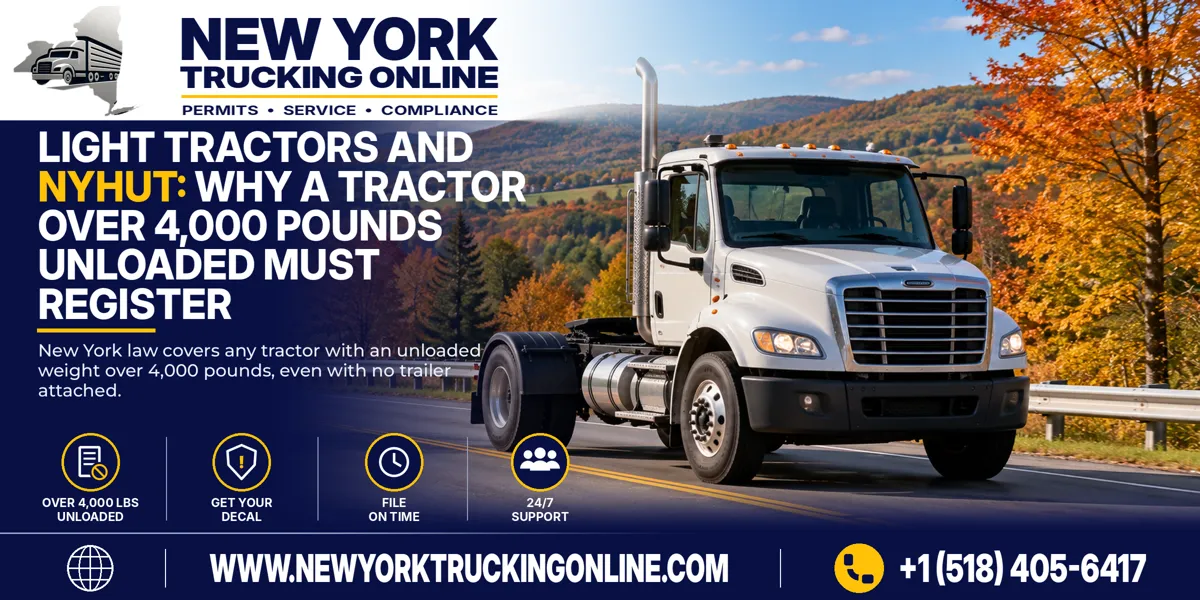
Light Tractors and NYHUT: Why a Tractor Over 4,000 Pounds Unloaded Must Register
Table Of Contents
-
Introduction
-
What NYHUT Covers
-
The Three Weight Tests in New York Law
-
Why Light Tractors Are Caught
-
How Gross Weight Is Figured for a Tractor
-
How a Light Tractor Is Taxed
-
Equipment That Is Not Covered
-
Penalties for Skipping Registration
-
Common Mistakes to Avoid
-
Why Many Trucking Companies Choose Our Service
-
FAQ
Introduction
Many carriers assume New York Highway Use Tax is only for big tractor-trailers. Then a smaller tractor gets stopped, and the driver learns it should have been registered all along.
New York law sets a much lower weight test for tractors than most people expect. This guide explains why a tractor with an unloaded weight over 4,000 pounds falls under NYHUT, how the tax is figured, and what happens if you skip registration.
What NYHUT Covers
NYHUT is New York's Highway Use Tax under Article 21 of the New York Tax Law. Section 503 says the tax is based on the gross weight of each motor vehicle and the number of miles it is operated on public highways in New York.
Carriers subject to the tax need a certificate of registration and a decal for each covered vehicle. The statutory fee for the certificate and decal is $1.50.
The Three Weight Tests in New York Law
Section 501 of the Tax Law defines a "motor vehicle" for NYHUT as any automobile, truck, tractor, or other self-propelled device used on public highways that has:
-
A gross weight over 18,000 pounds, or
-
For a truck, an unloaded weight over 8,000 pounds, or
-
For a tractor, an unloaded weight over 4,000 pounds.
The tractor test is the lowest of the three. A tractor does not have to be heavy to be covered. It only has to weigh more than 4,000 pounds empty.
Why Light Tractors Are Caught
Almost every tractor on the road weighs more than 4,000 pounds unloaded. That includes:
-
Medium-duty day cab tractors used for regional or local freight.
-
Smaller tractors that pull light trailers or equipment.
-
Older or lighter tractors that a carrier may not think of as "heavy."
The law looks at the tractor by itself, with no trailer and no cargo. So a carrier that reasons "my combination is light" can still be wrong. Under the definition, the tractor's own empty weight decides whether it is a motor vehicle for NYHUT.
How Gross Weight Is Figured for a Tractor
The 18,000-pound gross weight test also reaches more tractors than carriers expect. Section 501 defines gross weight as
-
The unloaded weight of the motor vehicle, plus
-
The unloaded weight of the heaviest trailer, semi-trailer, dolly, or other device it will draw, plus
-
The weight of the maximum load, not counting the driver and helper.
Because the heaviest trailer and the maximum load are added in, a working tractor usually passes 18,000 pounds gross very quickly.
There is one exemption to know. Section 504 exempts a motor vehicle with a gross weight of 18,000 pounds or less from the tax until the carrier elects to compute tax under the unloaded weight method. If you think a tractor fits this exemption, confirm the numbers with the New York Department of Taxation and Finance before you skip registration.
How a Light Tractor Is Taxed
New York gives carriers two ways to figure the tax. Rates are in mills per mile (one mill is one-tenth of a cent).
Gross weight method. The rate depends on the gross weight. For miles a tractor runs with no load, the law uses separate unladen rates based on the tractor's unloaded weight. An unloaded tractor running alone is taxed at the truck rate for its unloaded weight.
Unloaded weight method. A carrier may elect to pay based on unloaded weight instead. The tractor table in Section 503(3) includes:
-
4,001 to 5,500 lbs: 6 mills
-
5,501 to 7,000 lbs: 10 mills
-
7,001 to 8,500 lbs: 14 mills
-
8,501 to 10,000 lbs: 18 mills
-
10,001 to 12,000 lbs: 25 mills
-
12,001 lbs and over: 33 mills
For example, a tractor weighing 9,000 pounds unloaded pays 18 mills, or $0.018 per mile. At 10,000 New York miles, that is $180 for the period.
The election can only be made on the first return of the calendar year, and it is irrevocable for the rest of that year.
Miles on tolled portions of the New York State Thruway are not counted as public highway miles for these rates.
Equipment That Is Not Covered
Section 501 leaves certain equipment out of the definition, including:
-
Road rollers, tractor cranes, truck cranes, and power shovels
-
Road-building machines, snow plows, road sweepers, and sand spreaders
-
Well drillers
A regular highway tractor is not on this list.
Penalties for Skipping Registration
Section 512 sets civil fines for anyone who fails to obtain a certificate of registration or decal:
-
First violation: $500 to $2,000
-
Second or later violation within three years: $1,000 to $3,500
Late returns and late payments also carry a 10 percent penalty plus 1 percent per month, up to 30 percent, along with interest. A $1.50 certificate is far cheaper than a fine.
Common Mistakes to Avoid
-
Using the truck test for a tractor. Trucks use 8,000 pounds unloaded. Tractors use 4,000 pounds.
-
Judging by the cargo. The tractor's empty weight alone can trigger NYHUT.
-
Forgetting the heaviest trailer. Gross weight includes the heaviest trailer the tractor will pull.
-
Missing the election window. The unloaded weight method must be chosen on the first return of the year.
-
Counting tolled Thruway miles. They are excluded from the mileage used for these rates.
Why Many Trucking Companies Choose Our Service
New York Trucking Online helps carriers check whether each tractor needs NYHUT registration, choose the right reporting method, and keep certificates and decals current. We also handle the other New York permits your trucks may need.
-
Trip permit: $105
-
Fuel permit: $115 for 1 truck, plus $130 for each additional truck
-
Oversize permit: $97
We provide support 24/7 and also work weekends and holidays.
or
FAQ
-
What is the NYHUT weight test for tractors?
A tractor with an unloaded weight over 4,000 pounds is a motor vehicle under the New York Highway Use Tax law.
-
Is the test different for trucks?
Yes. A truck is covered when its unloaded weight is over 8,000 pounds, and any vehicle is covered when its gross weight is over 18,000 pounds.
-
How much does a NYHUT certificate and decal cost?
The statutory fee is $1.50.
-
What is the fine for not registering?
$500 to $2,000 for a first violation, and $1,000 to $3,500 for a repeat violation within three years.
-
Do Thruway miles count?
Miles on tolled portions of the New York State Thruway are excluded from the public highway mileage for NYHUT rates.
For more information, visit the New York State Department of Taxation and Finance.