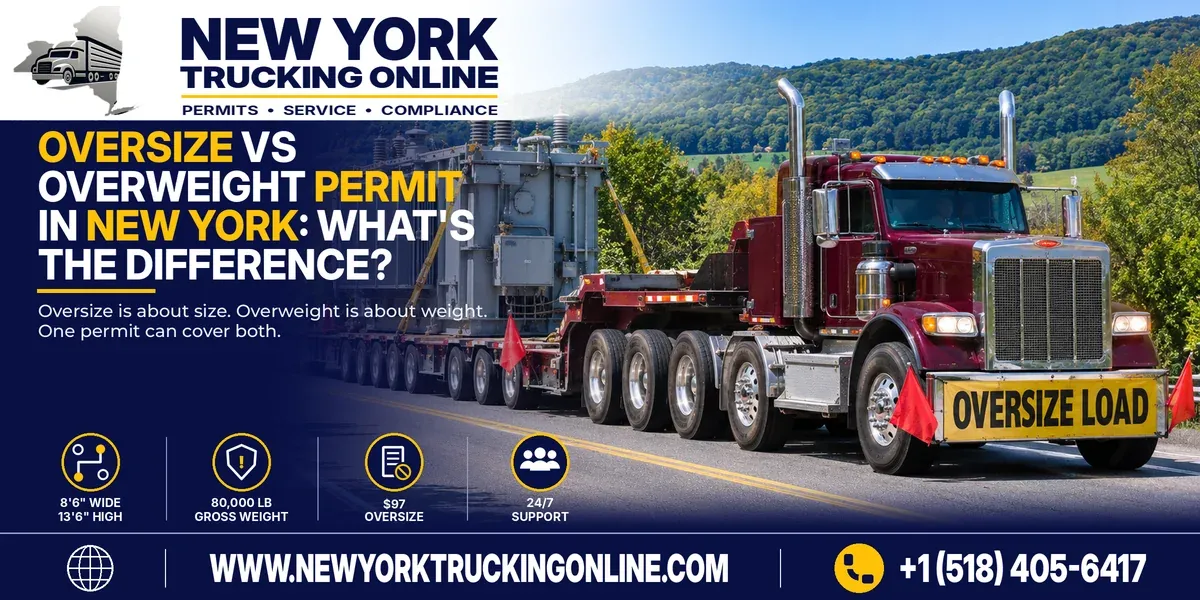
Oversize vs Overweight Permit in New York: What's the Difference?
Table Of Contents
-
Introduction
-
The Short Answer
-
New York's Legal Size Limits
-
New York's Legal Weight Limits
-
What Makes a Load Oversize
-
What Makes a Load Overweight
-
When a Load Is Both
-
The Non-Divisible Load Rule
-
Side-by-Side: Oversize vs Overweight
-
Which Permit Types Cover Each
-
Common Mistakes to Avoid
-
Why Many Trucking Companies Choose Our Service
-
FAQ
Introduction
Carriers often use "oversize" and "overweight" as if they mean the same thing. They don't. One is about the dimensions of the truck and load, and the other is about how heavy it is. In New York, both are handled through a special hauling permit from the New York State Department of Transportation (NYSDOT), but the details that go on the application, and the rules that come with the permit, depend on which limit the load goes over.
This guide explains the difference, shows New York's legal limits, and helps you figure out what your load needs before you apply for a New York Oversize Permit.
The Short Answer
-
Oversize means the load is too wide, tall or long for New York's legal limits.
-
Overweight means the load is too heavy, either in gross weight or on one or more axles.
-
A load can be one, the other, or both.
New York's size and weight limits are set in Vehicle and Traffic Law (VTL) section 385, and the permit rules are in 17 NYCRR Part 154.
New York's Legal Size Limits
These are the general size limits most carriers plan around:
| Measurement | Legal Limit |
|---|---|
| Width | 8 feet 6 inches on qualifying highways, 8 feet on other roads |
| Height | 13 feet 6 inches |
| Semitrailer length | 53 feet on qualifying highways, 48 feet on other roads |
A load that goes over any one of these limits is oversize, even if it's light.
New York's Legal Weight Limits
New York's weight limits look at the whole vehicle and at each axle:
| Measurement | Legal Limit |
|---|---|
| Gross weight | 80,000 pounds |
| Single axle | 22,400 pounds |
| Tandem axle | 36,000 pounds |
A load is overweight when it goes over the gross limit, or when one axle or axle group carries more than its limit. A truck can be under 80,000 pounds and still be overweight if the weight sits badly on the axles.
What Makes a Load Oversize
Oversize is about space on the road. Common oversize loads in New York include:
-
Bulldozers and excavators wider than 8 feet 6 inches
-
Modular building sections and storage tanks
-
Long beams, poles and bridge girders
-
Tall machinery that goes over 13 feet 6 inches on the trailer
Because oversize loads take up more room, the permit focuses on route, travel time, signs, flags and escorts. Wider and longer loads face more of these conditions.
What Makes a Load Overweight
Overweight is about what the road and bridges can carry. Common overweight loads include:
-
Transformers and generators
-
Heavy cranes and crane components
-
Large construction equipment on a lowboy
-
Steel coils and castings
An overweight permit focuses on axle weights, axle spacing, tires and bridges. NYSDOT reviews whether the route can safely handle the load, and a heavy load may be sent around bridges that can't support it.
When a Load Is Both
Many big loads are both oversize and overweight. A large excavator on a lowboy, for example, can be over 8 feet 6 inches wide and over the axle limits at the same time.
In that case, one New York Oversize Permit application covers both. The application lists the full dimensions and the weights, and the permit carries conditions for each, such as escorts for the width and an approved route for the weight.
The Non-Divisible Load Rule
Oversize and overweight permits are generally issued for non-divisible loads. A non-divisible load is one that can't be broken down into smaller pieces without damaging it or making it unusable, such as a single machine or a beam.
-
A single bulldozer is non-divisible.
-
A load of gravel, lumber or pallets is divisible and should be split or reduced to stay legal.
If a load can be reduced to meet the limits, NYSDOT generally expects the carrier to do that instead of asking for a permit.
Side-by-Side: Oversize vs Overweight
| Topic | Oversize | Overweight |
|---|---|---|
| What it measures | Width, height, length | Gross and axle weight |
| Main concern | Space and clearance | Roads and bridges |
| Key details on the application | Dimensions and overhang | Axle weights and spacing |
| Typical conditions | Signs, flags, escorts, travel hours | Route, bridges, axle limits |
| Rules | VTL 385, 17 NYCRR Part 154 | VTL 385, 17 NYCRR Part 154 |
Which Permit Types Cover Each
New York offers several kinds of special hauling permits under 17 NYCRR 154-1.2, including:
-
Single trip permits for one move over a set route
-
Blanket permits for repeat moves within set size and weight caps
-
Radius permits for moves within 25, 50 or 100 air miles of a home base
-
Annual crane permits for self-propelled cranes
Each type has its own limits for size and weight. Pick the one that fits both the dimensions and the weight of your load. Remember that a NYSDOT permit isn't valid in New York City, which issues its own permits.
Common Mistakes to Avoid
-
Checking only the gross weight. A truck under 80,000 pounds can still be over on one axle.
-
Measuring without the trailer. Height is measured from the road, not the deck.
-
Leaving out overhang. Front and rear overhang count toward length.
-
Hauling a divisible load on a permit. Reduce it to legal limits instead.
-
Forgetting New York City. A state permit doesn't cover city streets.
Why Many Trucking Companies Choose Our Service
New York Trucking Online helps carriers get the right New York Oversize Permit for loads that are too big, too heavy or both, with accurate dimensions, axle weights and routes, so the truck can move without delays.
- Oversize permit: $97
We provide support 24/7 and also work weekends and holidays.
or
FAQ
What is the difference between oversize and overweight?
Oversize is about width, height or length. Overweight is about gross or axle weight.
Can one New York permit cover both?
Yes. One application lists the dimensions and the weights, and the permit covers both.
What is the legal gross weight in New York?
80,000 pounds, with axle limits of 22,400 pounds single and 36,000 pounds tandem.
What is the legal height in New York?
13 feet 6 inches.
Can I get a permit for a divisible load?
Generally no. Divisible loads should be reduced to legal limits.
For more information, visit the New York State Department of Transportation.